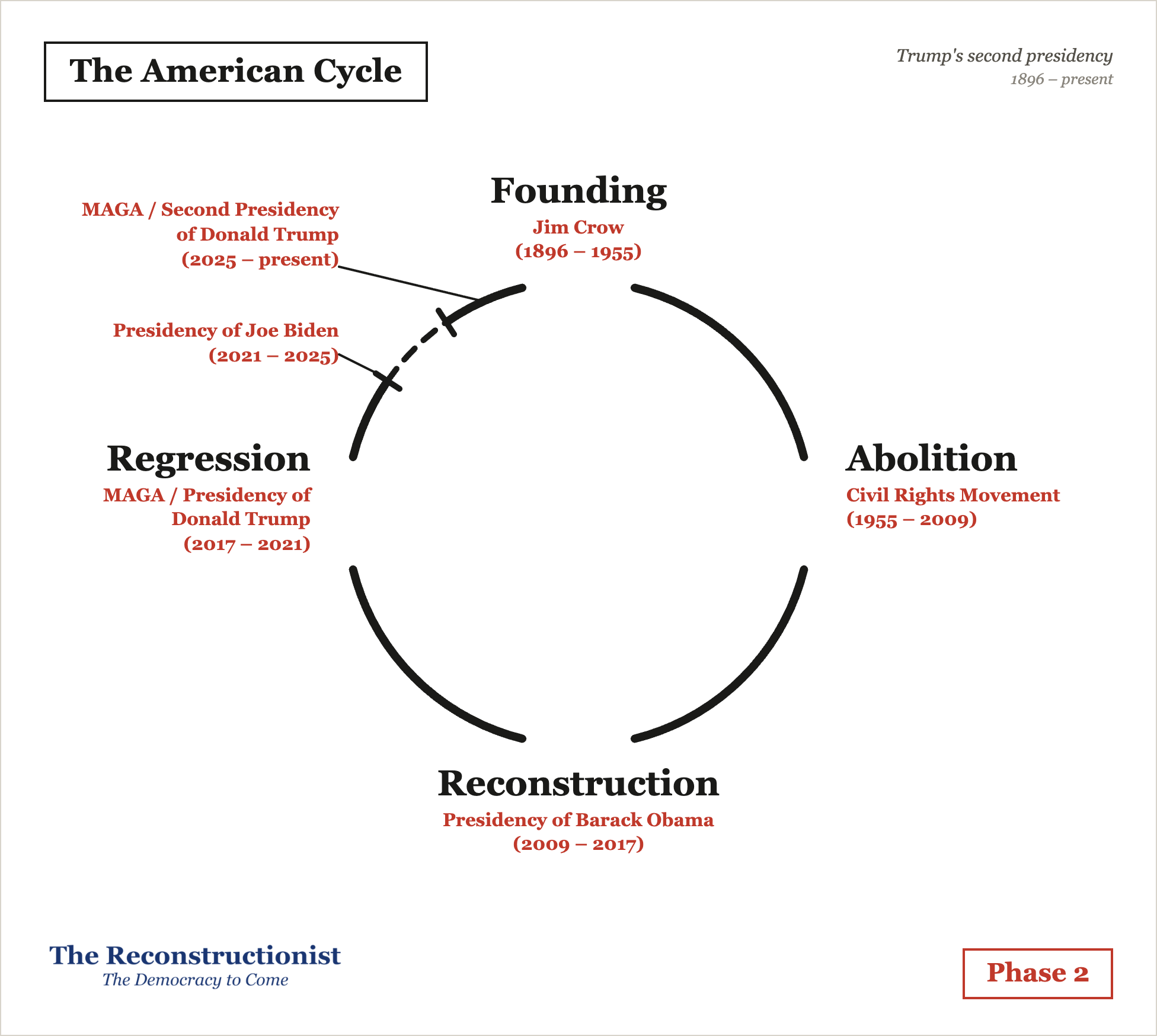
This essay is part 2 of a two part series and you can read part 1 here.
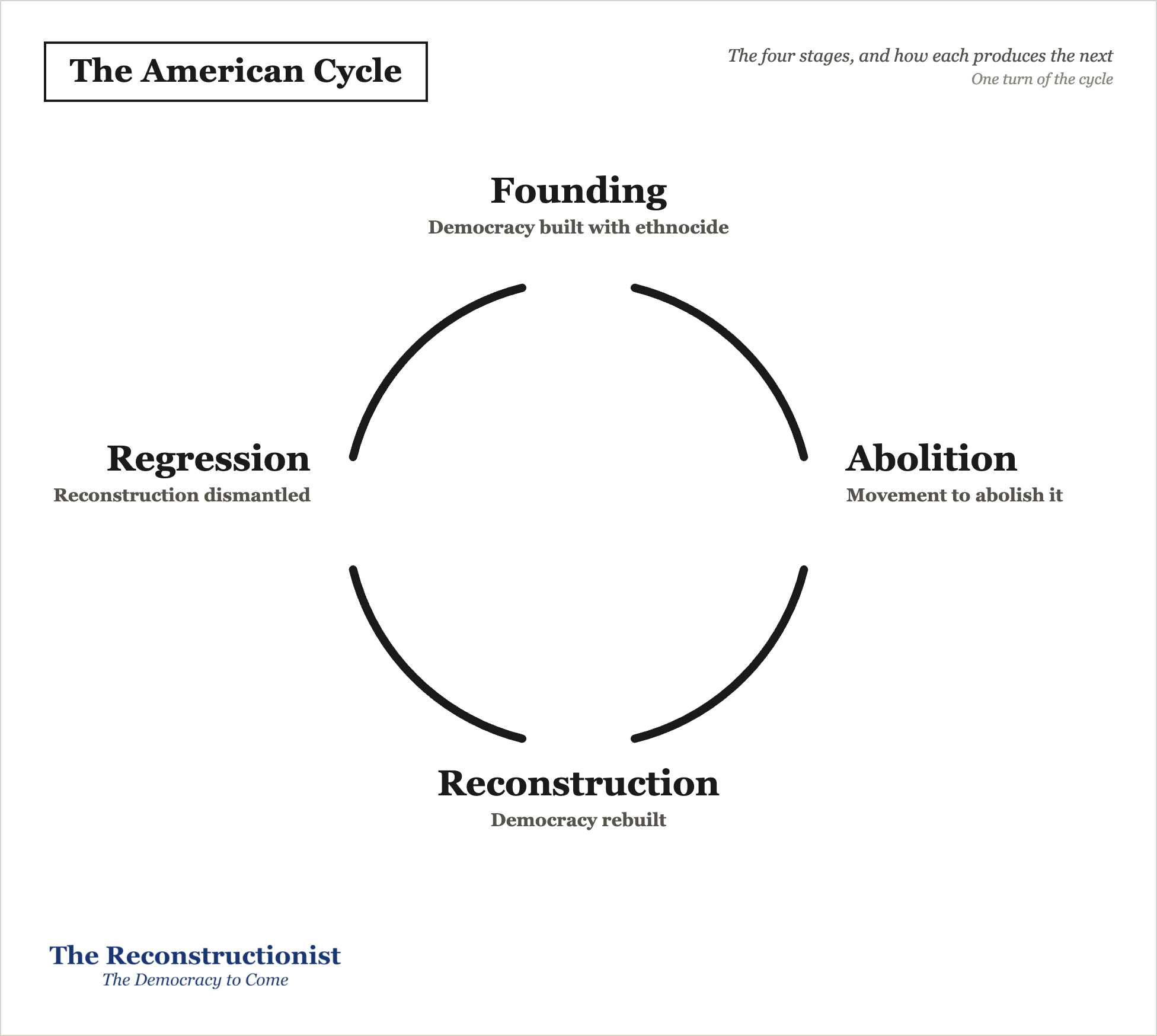
Phase 2 of the American Cycle has always been far more controversial than Phase 1.
The American Cycle from 1776 to 1896 is pretty obvious and not controversial. It is clear that America had a Founding era created by our founding fathers that legalized slavery then had an abolitionist movement that prevailed and abolished slavery. Reconstruction followed the abolitionist movement and then following Reconstruction’s end in 1877 much of the progress of Reconstruction was erased in the last two decades of the 19th century. Almost no one disputes these facts, but many people have been very prone to disputing the idea that this regressive pattern has repeated itself.
Most people want to dispute the legitimacy of the American Cycle because it counters the progressive narrative that we have been taught to believe. The American Cycle does not proclaim that the moral arc of the universe bends towards justice and that progress is inevitable. In fact, it proclaims that the arc of the United States bends towards injustice and that regression is America’s most likely outcome. This can be a hard pill to swallow, and ever since I first wrote about the American Cycle in my book The Crime Without a Name: Ethnocide and the Erasure of Culture in America I have had countless people challenge me on the legitimacy of my theory.
Many people disagreed with me (and I address their arguments in this essay), but I have been most fascinated by those who have agreed with me but wanted me to be wrong. The American story that I had to tell was not a story that they wanted to be true. Intellectually, they agreed with me, but emotionally they could not. However, Donald Trump’s second presidency has changed many people’s emotional response to the American Cycle. Trump’s return has proven that the regression that I predicted was, in fact, possible and now people have become more interested in breaking the American Cycle than denying its existence.
Prior to 2024, most people challenged the legitimacy of the American Cycle via challenging if each new stage mirrored the previous one, and much of my energy was spent listening to and responding these concerns. This essay addresses these critiques.
However, the biggest challenge has always been people’s belief that Reconstruction was a “failure.” Trying to save America’s democracy by embracing the ideas and philosophy of a “failed” era did not compute to many people.
Reconstruction was allegedly a “failure” because it was too short or did not accomplish enough, and many people argued Reconstruction’s “failure” meant that we should focus more attention on the successes of the Civil Rights Movement of the 1960s and 1970s. This response was perplexing because many of the successes of the Civil Rights Movement were obvious extensions of Reconstruction. How could the era that created civil rights, expanded voting rights to Black men, and established equal protection under the law for all Americans be a failure, but the era that used these precedents 100 years later to create the Civil Rights Act of 1964, Voting Rights Act of 1965, and invoked the equal protection clause of the Fourteenth Amendment in Loving v. Virginia and Roe v. Wade be a success?
This objection initially confused me, but it also reminded me that most Americans have been taught very little about Reconstruction, and that for the most part, we have been taught that it was a failure. This argument echoed the narrative of the Dunning School of the early 20th century that argued that Reconstruction failed because of Republican corruption and Black incompetence. For well over a century, Reconstruction has been depicted as a failure or minor footnote in American history, so I understood this perspective. However, I also knew that Americans had been taught a false narrative, so in order for people to see the American Cycle I had to become even more of a historian of Reconstruction so that I could educate people about America’s authentic history.
Yet despite my attempts to educate people about Reconstruction, prior to 2024, most people still remained reluctant to emotionally accept the narrative of American Cycle. Over the last year and a half, I have noticed a significant shift in people’s receptivity to my work and this theory.
With each passing year, the accuracy of the American Cycle has continued to increase, and it now should be obvious to everyone who cares about America’s democracy that we cannot afford to allow the Cycle to enter into a third phase and create a third Found era, or a second Jim Crow.
Once we accept the legitimacy of the American Cycle, we should also understand the urgency of breaking the Cycle and continuing Reconstruction. Reconstructionism and becoming a Reconstructionist consist of saving our democracy and breaking the American Cycle.
Jim Crow: America’s Second Founding 1896 - 1954 (Phase 2)
Jim Crow segregation is merely a 20th century attempt at recreating the chattel slavery of America’s first Founding era. America had created another racial caste system, and ethnocide was again the basis for the division. The role of ethnocide becomes more visible during Jim Crow so it is important to take a moment to examine ethnocide a bit further.
In 1945, Polish Jewish refugee to the United States Raphael Lemkin coined the term “genocide” to describe the atrocity being inflicted upon Jewish people by the Nazis during World War II, but he also coined “ethnocide” at the same time. For Lemkin, Jewish people were a “genos” or “people,” but they were also an “ethnos,” or “nation” or “culture.” Lemkin intended for the words to be used interchangeably, but what ended up happening was that the cultural destruction of ethnocide was subsumed into genocide. Essentially, when a society attempts to destroy or forcefully remove a people, the destruction of their culture is also part of the destruction. If you destroy a people their culture will also die with them.
Around the 1970s various anthropologists started thinking about ethnocide as independent from genocide, and as a result, ethnocide evolved into the destruction of a people’s culture while keeping the people. In my book The Crime Without a Name: Ethnocide and the Erasure of Culture in America I use ethnocide to describe the transatlantic slave trade and explain how American society was built around the normalization of ethnocide.
With ethnocide, the goal is not to live in the absence of a specific group of people. If the goal was to remove or eliminate a specific group of people that would be genocide. Genocide is an accurate term for the Black experience in the Americas because if European colonizers wanted to create a society in the Americas without African people, they would not have created the transatlantic slave trade.
With ethnocide, the goal is for the specific group of people to remain in the society, but to exist as a de-cultured mass of people that can be used and exploited by the dominant group in the society, yet to understand the pervasive and destructive impact of ethnocide—especially in relation to Jim Crow—one must have a clear understanding of what “culture” means.
Culture is often thought of as a vague and amorphous concept that all people have, but is hard to describe; when in fact, “culture” is very easy to define. Culture is simply the things that people in a shared environment create so that they can survive for as long as possible. Our language, clothes, houses, buildings, food, art, laws, freedom of movement, etc. are all examples of our cultural expression. The shared spirit of the people is also part of their culture. When examining Jim Crow, it becomes clear that white Americans constantly exerted their power to undermine Black Americans’ capacity to develop their own culture and/or create a shared culture with white Americans.
Ethnocide exists to destroy this collective culture and replace it with an unstable “culture” of division and oppression.
As Black people fought, and continue to fight, to preserve their African culture or make new culture in America, the dominant white population will attempt to destroy that culture and maintain racial inequality. Black towns will get destroy, the carceral state will destabilize Black families, low wages and a lack of government support will create housing, food, and educate insecurities, and poll taxes, literacy exams and other voter suppression methods will ensure that Black people will have little to no power or influence in America’s democracy.
This is Jim Crow segregation and it is also ethnocide. Ethnocide was the method for fueling the sustained division and inequality of Jim Crow that ensured that white Americans had the authority to destroy and undermine the culture and lives of Black Americans.
The 1921 Tulsa Race Massacre is a great example of the ethnocidal destruction of Jim Crow. In the Greenwood neighborhood of Tulsa, Oklahoma, Black Americans had made a prosperous town whose prosperity earned it the moniker of “Black Wall Street.” For the white residents of Tulsa, the problem did not reside with the existence of Greenwood. The existence of an adjacent Black community was not the problem: in fact, it was the goal. The problem arose because Greenwood had become so prosperous that white Americans may no longer be able to control the lives of the Black residents. The potential for equality was the problem. The existence of a self-sustaining and nurturing Black culture was the problem. For the racist, white residents of Tulsa, the solution was to destroy the town of Greenwood: to destroy the culture that the Black residents of Greenwood had built.
From May 31 to June 1, 1921 (only two days), the white residents of Tulsa destroyed 35 blocks of Greenwood, sent over 800 people to the hospital, and killed more than 300 people. Prior to this act of white terrorism, Greenwood was a thriving community with over 10,000 residents. Roughly 9,000 people survived, but the culture of Greenwood had been destroyed.
More than a decade later and a continent away, Adolf Hitler’s Nazi Party on November 9-10 engaged in a similar terrorist attack against German Jews that became known as Kristallnacht or “the Night of Broken Glass” when they systematically attacked Jewish culture by destroying Jewish business and synagogues across the Germany, Austria, and the Sudetenland. Nearly 100 people died during Kristallnacht and roughly 30,000 Jewish men were rounded up and sent to concentration camps.
In the genocide of Nazi Germany, the survivors of the terrorist attack were sent to concentration camps, but in the ethnocide of Jim Crow America, the survivors were instructed to “know their place” and to live in a state of perpetual fear if they ever attempted to live equally with white Americans. The culture was destroyed but the people remained. This is the same underlying dynamic of chattel slavery and America’s first Founding era.
Greenwood was not the only culturally destroying race riot in America during Jim Crow, and similar race riots occurred across America. Prior to destroying entire neighborhoods, segregation, which shaped every facet of Black life, aspired to keep Black people in the “place” where white Americans wanted them to be. Any attempts at challenging this caste structure and attempting equality was met with violence. The Ku Klux Klan (which was outlawed in the 1870s during Reconstruction) came back and their terrorism became a normalized facet of American life and lynchings became commonplace across the South.
The racial terror of the American South meant that six million Black Americans fled the South during the Great Migration that lasted the duration of Jim Crow. Every decade a million Black Americans left the South and sought sanctuary in other parts of America. The Great Migration is another manifestation of the Underground Railroad. It is an act of Black abolition that precedes the commencement of the Abolition Era.
As a result of the normalized cultural erasure of Jim Crow, the narrative of the first half of the 20th century is often depicted as if Black Americans are secondary or have been removed from the narrative, when in fact, the defining feature of this era was the destruction of the equality of Reconstruction and a return to racial inequality and a facade of democracy. The story that Americans are often told of America’s Second Founding era consists of talking about the Progressive era, the Roaring Twenties, the Great Depression, World Wars I and II, the New Deal, and the nuclear family, but Jim Crow segregation, or apartheid, directly influenced all of these eras. (“Apartheid” means “separateness” or “apartness” in Afrikaans, so it is also synonymous with “segregation.”) Segregation and Jim Crow was not a secondary factor of this era, but the defining factor of the era.
At a bare minimum, it must also be acknowledged that this era was defined by America’s two political parties having little to no interest in racial equality, and the Democrat Party having a disproportionate degree of influence in American politics due to their capacity to suppress the Black vote. Due to the abolition of slavery and the creation of Black male suffrage during Reconstruction, Black Americans were no longer considered to be three-fifths of a person for congressional apportionment and electoral college delegates. Black Americans counted as full-persons or “five-fifths” during Jim Crow, but the prevalence of poll taxes, literacy exams, felon disenfranchisement policies, and the threat of white terrorist violence meant that the vast majority of Black Americans did not vote. As a result, Southern Democrats actually gained political influence–from three- to five-fifths–due to their ability to suppress the Black vote.
From 1896 to the start of the Civil Rights Movement in 1955, America’s political parties were united in their commitment towards racial inequality in America, so it is absurd to champion the ideals of this era as a means for cultivating equality in a multiracial democracy. Any semblance of cultural stability, progress, or togetherness that emerged from this era is a direct result of the political commitment from both political parties to sustain racial inequality and apartheid in America.
The demise of Jim Crow mirrors the demise of America’s first Founding era because this era exists in perpetual tension between the Americans who champion equality and authentic democracy and those who champion inequality and inauthentic democracy. This tension will inevitably result in a second Abolition era that centers on abolishing Jim Crow and starts with the Civil Rights Movement of the 1950s.
America’s Second Abolition 1955 - 2009 (Phase 2)
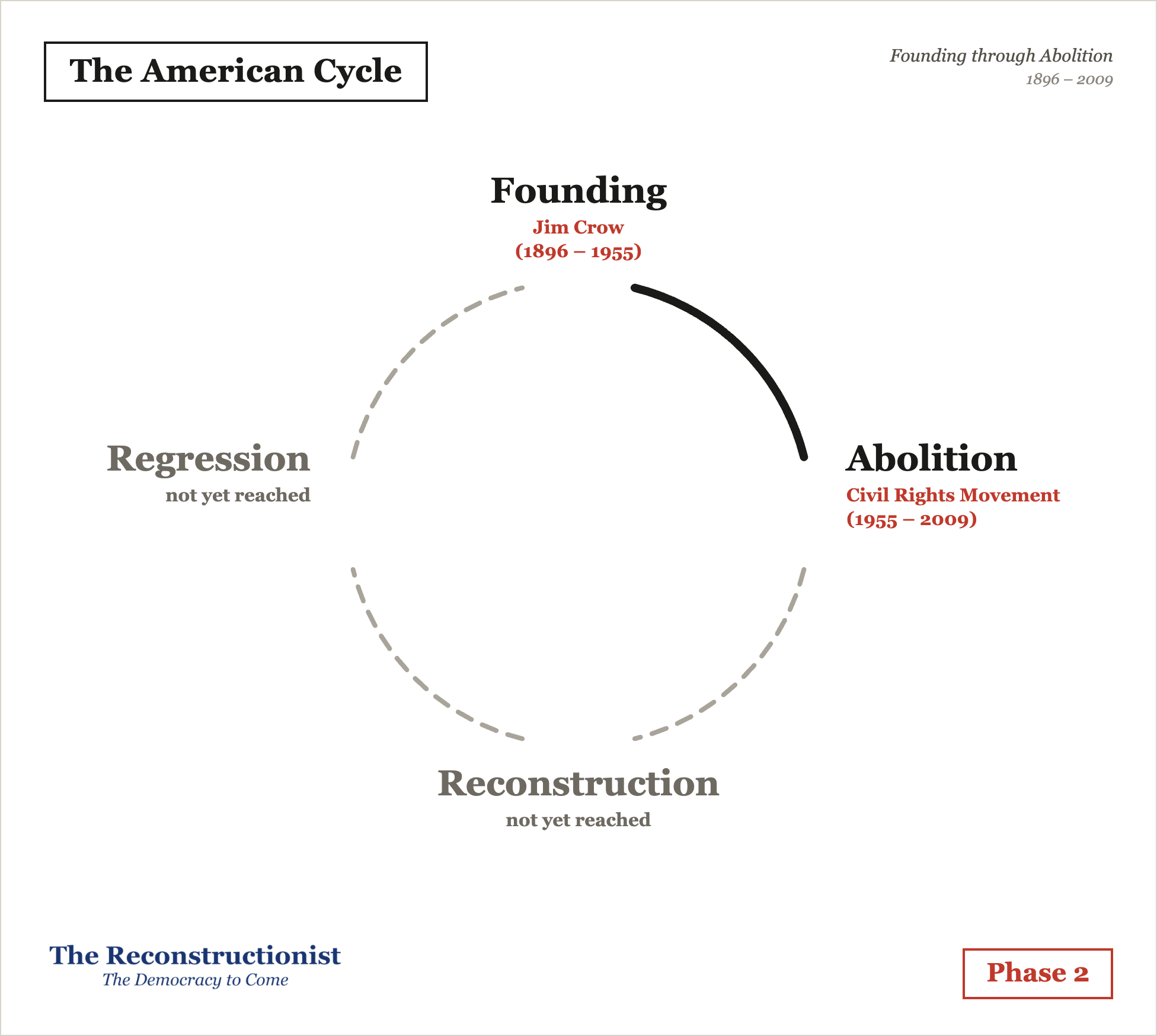
America’s second Abolition Era began in 1954 with the Supreme Court’s decision in Brown v. Board of Education that overturned Plessy v. Ferguson and “separate but equal” by stating that separate facilities are inherently unequal, and it continued until the presidency of Barack Obama in 2009. What was unconstitutional in 1873 in Railroad Company v. Brown was again unconstitutional nearly 80 years later, yet it still took more than 50 years to abolish the myriad of segregationist policies created during Jim Crow.
The reason why the second Abolition lasted more than 50 years is due to the fact that Reconstruction made it unconstitutional to explicitly use race as a justification for division and inequality, so unlike the first Abolition era, which could focus explicitly on slavery, the second had to tackle countless facets of Jim Crow that used race neutral language to create racist outcomes. America’s second wave of abolitionists had to wait for the racist outcomes, and this will extend the window of abolitionism. America’s second Abolition will last just as long as Jim Crow.
Also, some historians refer to the Civil Rights Movement from the 1950s to the 1970s as a Second Reconstruction, but the American Cycle framework classifies it as part of the second Abolition era because the intent of this era was the abolition of Jim Crow. However, the existence of Reconstruction can complicate this distinction because abolishing Jim Crow will eventually result in the return of Reconstruction, and you can see facets of Reconstruction’s return during this era: including the Civil Rights Act of 1964 and Voting Rights Act of 1965.
Unlike America’s first era of Abolition, the second had a previous era that they wanted to bring back through abolition. The fight to abolish slavery in the 1840s and 1850s did not aspire to rekindle the spirit of a previous era of American life without slavery because that era had never existed. The first Abolition era was abolition without any return and then once abolition prevailed the abolitionist could become Reconstructionists and implement Reconstruction. In America’s second Abolition era, once aspects of Jim Crow were abolished components of Reconstruction had the opportunity to return, but America’s second Reconstruction will still occur after the abolition of Jim Crow. The agenda of desegregation linguistically speaks to the goal of abolishing Jim Crow segregation.
During America’s second Abolition era, America experienced many iterations of Black empowerment with the goal of abolishing Jim Crow, albeit with various and often competing methodologies. Martin Luther King Jr.’s philosophy of nonviolence coexisted alongside the Nation of Islam, Malcolm X, the Black Panthers, the Black nationalism of Marcus Garvey, and the legal strategies of Thurgood Marshall. And as in the first Abolition, the second also had a tipping point moment when prominent white Americans joined the cause for abolition. In the 1960s, President John F. Kennedy’s support for civil rights and collaboration with Black civil rights leaders helped create a multiracial Civil Rights Movement in America that included white Americans, too. JFK’s allyship was akin to John Quincy Adams representing the Mende Africans aboard the Amistad in the Supreme Court. JFK’s support for civil rights extended to his vice president and successor Lyndon B. Johnson, and his brother Attorney General Robert F. Kennedy.
Additionally, JFK’s support of civil rights radically changed American politics because neither the Democrat nor Republican parties could continue as two parties who supported the status quo of American racial apartheid. The Democrat Party of JFK decided to embrace civil rights, and as a result, Black voters, who had remained loyal to the Republican Party since Reconstruction, switched their political allegiance to the Democrats. There is an irony in this shift because in the late 1800s, the Democrats proclaimed themselves to be the party of the people, but they explicitly meant white people and they advanced their agenda of “separate but equal” in defense of the racist white people they were committed to defending. In the 1960s, JFK and the rest of the Democrat Party decided that “people” meant all people regardless of race or religion. As a result of welcoming Black Americans into the Democrat Party, the racist white members decided to leave the party.
The Republican Party, which could have also chosen to embrace civil rights, went in the opposite direction and decided to embrace the racist members of the Democrat Party–most of whom were from the South. These Democrats called themselves Dixiecrats because they embraced the racist ideals of Jim Crow and the Confederacy. There is also an irony around this political shift because following Reconstruction’s collapse, the Republican Party had become more concerned with business and industry than with racial equality, and one of the primary reasons they became less concerned with racial equality in the 1880s was because they wanted to expand northern industries into the South. Starting in the 1880s, the Republican Party became the party of business elites who openly wanted to collaborate and do business with racist Southerners, and this political identity held firm throughout Jim Crow. When the racist members of the Democrat Party were no longer welcomed within their own party, the GOP welcomed them into the fold.
Essentially, not only was the remaking of America’s political parties in the 1960s based around race and civil rights, but the identities of the Democrat and Republican parties that influenced the shift were forged in the aftermath of Reconstruction when both parties shunned racial equality and had to rebrand themselves. America’s first Abolition resulted in the collapse of the Whig Party and the birth of the Republican Party, and America’s second Abolition completely inverted the identities of America’s two parties. In the 1960s, the Republicans defended the ideals of the South, and the Democrats championed civil rights and racial equality. In the 1860s, it was the inverse.
Additionally, as Jim Crow segregation was being abolished piece by piece, American courts started invoking the principles of the Reconstruction Amendments as a means for championing civil rights. The Supreme Court invoked the due process clause of the Fourteenth Amendment in both in Loving v. Virginia in 1967 that legalized interracial marriage and in Roe v. Wade in 1973 that legalized abortion.
However, as Democrats and civil rights leaders worked to dismantle and abolish Jim Crow, Republicans and segregationists fought to keep it alive and their methods included one of the primary features of Phases 1 and 2 of the Founding era, the founding of America and Jim Crow: race neutral language and obfuscated intent.
The defenders of Jim Crow married their race neutral language that would serve as the bedrock of various policies, legislation, and legal theories with a resurgence of race-based terrorism. To name a few, civil rights leaders Martin Luther King Jr. and Medgar Evars were both assassinated by white supremacists, and countless other civil rights advocates were beaten, terrorized, and murdered across the nation.
Since the collapse of Reconstruction in 1877 and into Jim Crow, the United States had normalized a discourse that at face value sounded race neutral, yet existed to fuel racial division. The prevalence of a dishonest language creates a beguiling problem because one can never be sure if people are aware of the underlying division at the heart of their words. This linguistic dishonesty further complicates the task of abolitionists because the destruction of a Jim Crow era policy will then get replaced by a new policy that was created to sustain racial division but does not include racist language.
For example, during Jim Crow most white children in the South attended segregated public schools and the Southern states invested more money into the white schools than the Black schools. When school desegregation was being enforced across the South, many white families took their children out of public schools and enrolled them in private schools, and then Southern states created various policies such as tax breaks and vouchers so that white families could afford to send their children to private schools. These policies would often coincide with a reduction in funding for public schools. These policies were not explicitly racist in their language, but they were created to help sustain a segregated society. Additionally, attending one of these private schools does not make someone a racist, but this is an example of the dilemma that occurs when language is intentionally dishonest. Americans can have no racist intent or be unaware of the racist history, yet actively engage in racist institutions because the language of racial division has been erased yet the intent can still remain.
Similarly, in the late 1970s, Republican lawyers developed the legal doctrine of originalism that states that the U.S. Constitution should be interpreted according to the intent of the Founding Fathers, and they developed this doctrine to counter the progressivism of the Supreme Court and their application of the Reconstruction Amendments that resulted in Loving v. Virginia and Roe v. Wade. The premise of this doctrine is that the ideals of the Founding era, both the first and the second, should guide our interpretation of the Constitution. It is a doctrine committed to countering abolition and dismantling Reconstruction.
In the 1980s, 1990s, and 2000s, the fight to abolish the vestiges of Jim Crow continued: Education, housing, policing, incarceration, and voter enfranchisement remained vital issues in the continued struggle for civil rights and equality. As the struggle to dismantle Jim Crow continued, so did the voices of Black Americans because each demand for equality equated to a micro-abolition of Jim Crow. During these decades, the influence of Black voters continued to grow in American politics, and became increasingly significant in the politics of the Democrat Party. It is not a coincidence that after JFK, the Democrats only won the presidency during this era when their candidate hailed from the South. The growing influence of Black voters in the South empowered Jimmy Carter and Bill Clinton to win enough states in the South to win the presidency.
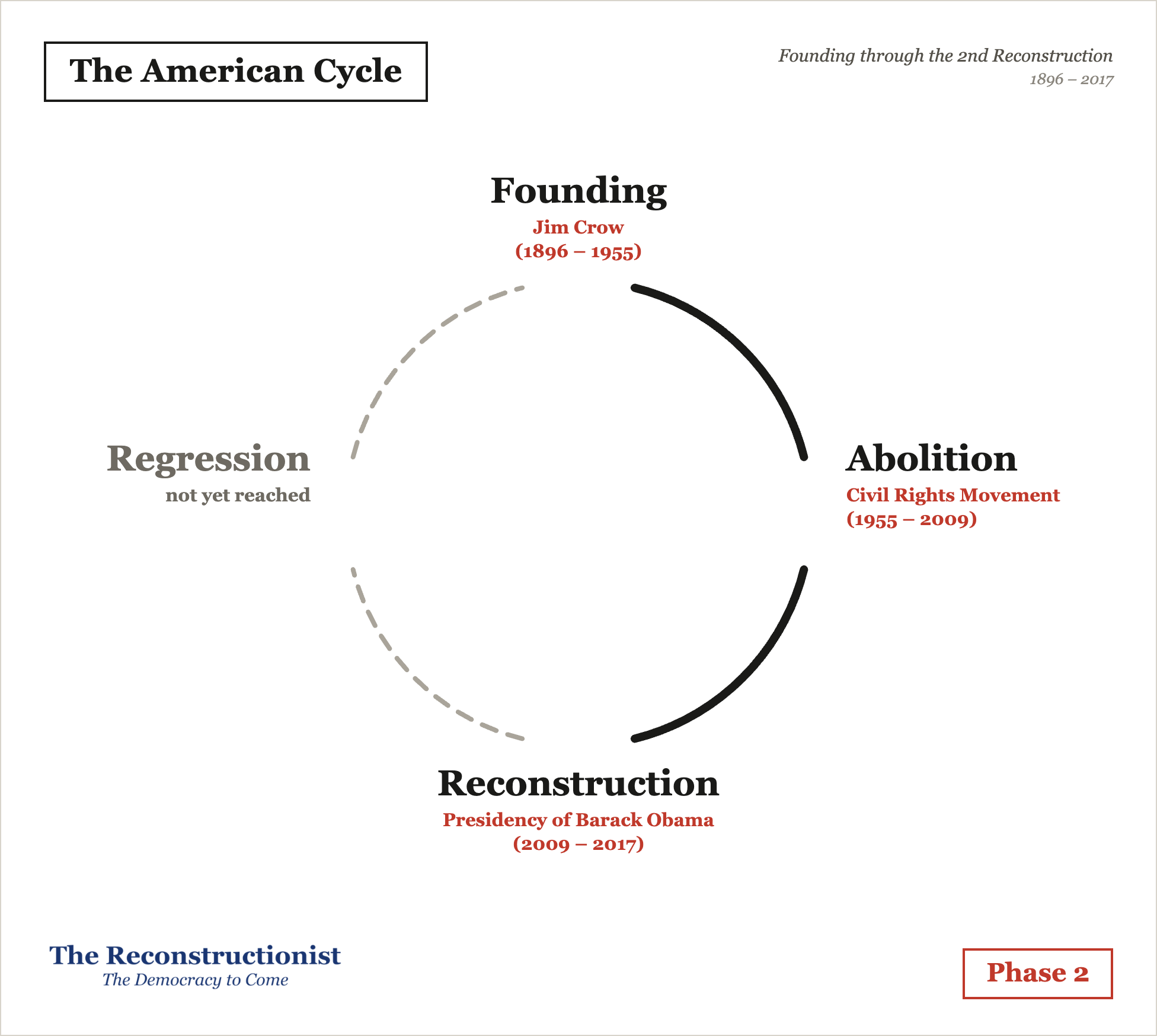
America’s second Reconstruction began when the influence of Black voters empowered America to elect its first Black president.
Obama’s Presidency: America’s Second Reconstruction 2009 - 2017 (Phase 2)
The election of America’s first Black president represents the beginning of America’s second Reconstruction, and demonstrates an obvious continuation of Reconstruction. However, the biggest distinction between America’s first and second Reconstructions is that the second lacked a clearly stated Reconstructionist policy and political agenda. In the 1860s and 1870s, America knew that they were engaging in Reconstruction, and the Republican Party actively created laws, policies, government departments, and constitutional amendments to further the agenda of reconstructing America. But during Obama’s presidency, Americans were unaware of the fact that they were in a second Reconstruction and the Democrats did not have an agenda of reconstructing America. America’s second Reconstruction consisted of the spirit and vibes of Reconstruction, but not the language and policy.
During America’s first Reconstruction, Black Americans were elected to the House of Representatives and the Senate, and held elected positions in state legislatures across the South. In fact, Louisiana actually had two Black governors during Reconstruction in Oscar Dunn and P.B.S. Pinchback, so if Reconstruction was allowed to continue after 1877 it should be obvious that a Black president would have occurred much sooner than 2009–132 years after Reconstruction’s collapse. Reconstruction only lasted twelve years (1865 to 1877), and if Reconstruction continued through 1896 – when the Supreme Court decided on Plessy v. Ferguson and “separate but equal” – it is not farfetched to imagine that the United States might have instead elected its first Black president by this time. (In comparison, Mexico elected their first Black president, Vicente Guerrero, in 1829 and abolished slavery that same year.)
America’s second Abolition era had abolished enough of Jim Crow to allow for the return of many of the lost rights and privileges of Reconstruction, and the election of a Black president represented the continuation of Reconstruction from where it left off in 1877.
Also, in hindsight, Obama’s presidency is often depicted as part of America’s natural progression toward equality and justice, but it is important to recognize that Obama’s success, at the time, was neither considered inevitable nor expected. Heading into the presidential primaries in 2008, Hillary Clinton and not Obama was expected to win the Democrat Party’s nomination. Obama was the outsider, upstart candidate who challenged the political establishment. At the time, many Americans, regardless of political affiliation, expressed skepticism about America being “ready” for a Black president. America’s second Reconstruction, like the first, was considered to be highly improbable, if not impossible, until it happened and then it became the new normal. Few Americans in the 1850s could have imagined that by 1865 (only eight years after the Dred Scott decision in 1857) that slavery would be abolished throughout the United States. In each epoch, Reconstruction was never viewed as inevitable.
When Obama won, his victory was largely contingent on being able to win the support of Black voters to a degree that had been unprecedented since Reconstruction. Obama not only won 95 percent of the Black vote, but Black voters also voted at a percentage that had been unprecedented since Reconstruction. Obama also lost the white vote by 12 points (John McCain won 55 percent and Obama won 43 percent), and this indicated that Democrats could still win the White House without needing too much of the white vote. This was a radical change on par with Reconstruction when the Fifteenth Amendment threatened to give the Republican Party an unassailable majority in the South due to the influence of Black voters.
Obama’s coalition of voters was unique to his presidency and was far from a replica or natural extension of the demographic breakdown that secured presidential victories for Bill Clinton in 1992 and 1996, and Jimmy Carter in 1976. Obama’s unique coalition of voters helped him win the presidency again in 2012, yet since then the Democrat Party has struggled to replicate Obama’s coalition with other candidates. The simple, yet incorrect, conclusion for this dilemma is that Obama is a uniquely gifted politician and it is impossible to replicate his appeal, but the better analysis centers on Reconstruction. A Black president embodied the spirit of Reconstruction and multiracial democracy, and a majority of Americans felt empowered by these ideals. The Democrats cannot recreate Obama and they have never articulated an agenda that focuses on Reconstruction (as of yet), and as a result, Obama’s absence means that both the spirit of Reconstruction and a multiracial electorate that can win the presidency also disappear.
Despite the absence of a clearly stated Reconstructionist policy agenda, Obama’s two signature accomplishments are an obvious continuation of the principles of Reconstruction.
The Deferred Action for Childhood Arrivals, or DACA, was akin to the birthright citizenship provision in the Fourteenth Amendment, in that it expanded the meaning of what it means to be an American. Despite not being as far reaching in scope nor granting citizenship to the children of undocumented immigrants, it still granted legal status for this community and allowed them to live freely within the United States.
The Affordable Care Act was also in the spirit of Reconstruction in that it expanded the role of the federal government to help ensure that all Americans could obtain health insurance. Prior to Reconstruction, these concerns were the domain of the states, but the creation of the Freedmen’s Bureau, the Department of Justice, and the Department of Education during Reconstruction radically altered the roles and responsibilities of the federal government. The Freedmen’s Bureau was the precursor to Franklin Delano Roosevelt’s New Deal in the 1930s, but the Freedmen’s Bureau’s emphasis on providing housing, education, and employment for the formerly enslaved meant that the federal government was reluctant to adequately fund it. In 1866, President Andrew Johnson even vetoed the bill to continue its funding and accused the Freedmen’s Bureau of being racist against white Americans and unconstitutional because it encroached on state’s rights.
Obama’s signature accomplishments echoed the spirit of Reconstruction, and unsurprisingly, so did the opposition from the Republican Party.
An often overlooked component of the progress of Reconstruction centers on the fact that for Reconstruction’s first eight years, the Republican Party effectively had no opposition party challenging their agenda. Following the Civil War, the Democrat Party still existed, but the federal government had not yet decided on what to do with the former Confederate states. Allowing the Confederate states to rejoin the Union in 1865 was not a viable option, but following their defeat in the Civil War, many Confederate leaders who had held elected offices prior to the war did attempt to reclaim their previous seats. Vice President of the Confederacy Alexander Stephens was a member of the House of Representatives from Georgia prior to the Civil War, and after the war he did return to Washington, D.C. and attempt to reclaim his previous seat. Upon arriving in Washington, D.C., it became clear that Stephens and his fellow Confederates had not changed their views on slavery and instead planned to bring the fight over slavery from the battlefield to the halls of Congress. In response, the Republicans refused to seat the former Confederates and delayed the readmission of the Confederate states back into the Union.
Republican President Andrew Johnson provided the strongest impediment to the Republican Party’s Reconstruction agenda, and he was impeached by his own party.
Eventually, the Southern states were allowed to rejoin the Union in 1868 after they had ratified the 14th Amendment, but the Republican Party still dominated the national elections in 1868. It was not until the elections of 1872 that the Democrats began to reclaim a political foothold in the South.
During Obama’s presidency, the Democrat Party had an opposition party and the obstinance of the Republican Party echoed that of the latter stages of Reconstruction. In the absence of a Republican Party, it is entirely possible that the Democrats would have created a much bolder and more ambitious agenda that mirrored the progress of Reconstruction’s first eight years.
Additionally, the rhetoric of the Republican Party during Obama’s presidency mirrored that of the Redeemer Democrats who opposed Reconstruction. The Tea Party movement and the challenging of Obama’s citizenship were efforts to delegitimize Black Americans and also harken back to a previous era of American life that was absent of the influence of Black Americans and supposedly represented America’s true ideals. Eventually, through the candidacy and eventual presidency of Donald Trump the rhetoric and agenda of the Republican Party–both the mainstream and the fringe–became “Make America Great Again” or MAGA, and this rhetoric is the same as the Redeemers except that it speaks to a national, and not a regional, “redemption.” During Trump’s campaign, he referred to Mexicans as rapists and one of his campaign pledges was to build a wall along the southern border. Trump’s rhetoric–starting with challenging Obama’s citizenship to the demonization of Mexicans–aspired to delegitimize non-white Americans, and this is the same playbook as the Redeemers from Reconstruction.
As MAGA grew and Trump’s campaign continued to grow in 2015 and 2016, Trump started gaining the support of white supremacist and paramilitary groups including the Proud Boys and the Oath Keepers. The uniting of MAGA with white, or predominantly white, militias also mirrors the partnership between Southern Democrats and white supremacist militias during Reconstruction.
Without explicitly invoking Reconstruction, both the Democrats and Republicans structured themselves after this era. Unbeknownst to both parties and the American public, 2009 to 2017 mirrored much of 1865 to 1877, and as in 1877, America’s second Reconstruction was ended by a resurgent MAGA/Redeemer movement. Except in 2017, MAGA occupied the White House and not just the South.
Lastly, it is also important to note that during the election of 1876, it was unclear who won the popular vote between Rutherford B. Hayes and Samuel Tilden. The contested elections in the South made it impossible to produce an accurate count. The winner was determined by the Republicans and Democrats making a deal and agreeing to award Hayes the necessary electoral votes from the South to win the presidency, so long as he removed federal troops from the South. In 2016, Trump did not win the popular vote when he defeated Hillary Clinton, but he did win the Electoral College, which remains a vestige of America’s first Founding era and has always given the South a disproportionate amount of influence in determining the presidency.
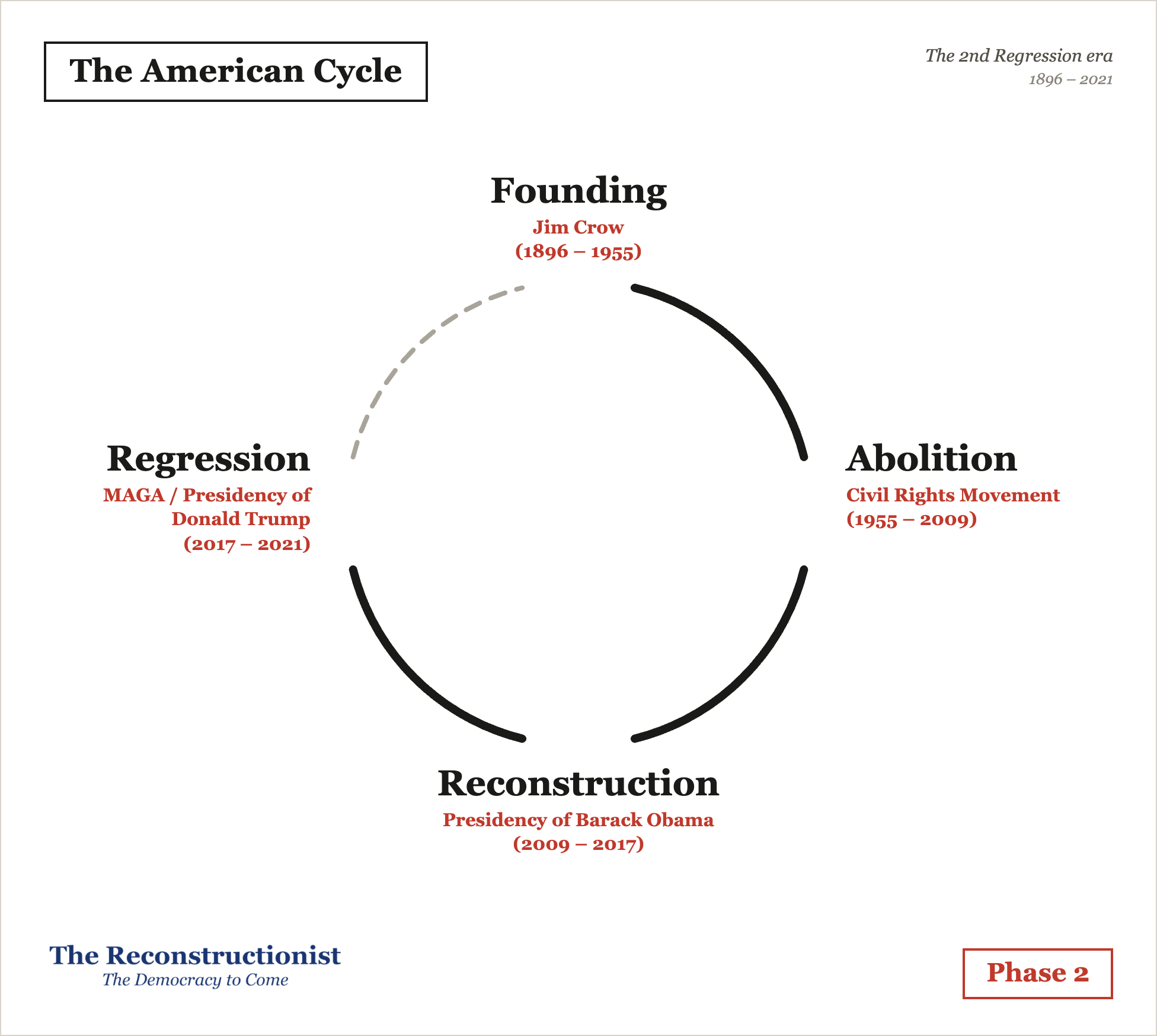
Trump’s First Presidency: America’s Second Regression (Phase 2)
Trump’s first presidency started America’s second Regression when we recommenced the process of moving away from multiracial democracy, and towards a more racially divided society.
Trump’s Muslim ban, promise to build a wall between Mexico and the United States, and referring to African nations as “shithole” countries all spoke to the racial division he aspired to create as part of his vision of Making America Great Again.
Trump’s rhetoric also emboldened white supremacists across the nation, and the Unite the Right march in Charlottesville, Virginia in August of 2017 highlighted the growing division and white supremacist agenda that Trump had emboldened. At the rally, white supremacists waved Confederate flags, wore Nazi paraphernalia, and chanted “the Jews will not replace us” as they marched through Charlottesville. The impetus for the rally was to protest the removal of a statue of Confederate General Robert E. Lee that had been erected in 1924. This rally in Charlottesville was also a perfect crystallization of the regressive nature of the American Cycle.
During Obama’s presidency, as Black voices became more prominent, the call to remove statues and monuments that celebrated the Confederacy spread across the nation. Americans understood that it was illogical to celebrate racist Americans who waged war against the nation. Likewise, the need to authentically tell the history and story of Black Americans became the new cultural norm, and in September of 2016, the National Museum of African American History and Culture opened in Washington, D.C. These developments represented a Reconstructionist cultural shift, and MAGA’s cultural mission consisted of preventing that shift toward authenticity, multiracial democracy, and equality. The Unite the Right rally was an expression of this regressive culture. Normalizing the Confederacy and celebrating the propaganda of the Lost Cause of the Confederacy were things that supposedly made America great. The destruction of Reconstruction was supposedly what made America great.
In 2016 and 2017, many Americans believed that Trump’s victory was a fluke and an aberration, but the Unite the Right rally should have made it abundantly clear that the hatred and division of this era was actually America’s natural trajectory. The present echoed the past and they were rallying in an attempt to preserve the remnants and ideology of America’s first Regression era.
In addition to the cultural shift of Trump’s presidency, his main political agenda was to erase the work and accomplishments of President Obama, and ending the Affordable Care Act became one of the defining issues of his first presidency. Trump never created an alternative plan for providing Americans with health insurance, but our society would allegedly become better if the accomplishments of our second Reconstruction were erased. The irony of this stance was that the Affordable Care Act was still very popular amongst Democrats and Republicans. Many Republican voters said that they do not support “Obamacare,” but did support the health insurance marketplaces that their states had created without knowing that these marketplaces were part of Obamacare, or the Affordable Care Act. Due to the Affordable Care Act’s popularity, Trump never got enough support within the Republican Party to end the Affordable Care Act.
Despite not accomplishing his legislative agenda, Trump’s and the Republican Party’s biggest accomplishment was the remaking of the Supreme Court so that it is dominated by a conservative ideology.
Following the death of Justice Antonin Scalia in February of 2016, the natural process would have been to commence the nomination process soon thereafter and appoint a new justice by the end of the year at the latest, but Senator Mitch McConnell and the Republican Party refused to adhere to tradition and prevented President Obama from appointing a new justice during his last year in office. At this time, the Supreme Court had a 5-4 conservative split, and replacing Scalia–one of the founders of originalism–with a more liberal justice would have shifted the power dynamics to a 5-4 liberal split.
After Trump’s victory, conservative lawyer Neil Gorsuch was confirmed to the Supreme Court. Soon thereafter, in 2018, Justice Anthony Kennedy resigned and conservative lawyer Brett Kavanaugh was confirmed to the Court that same year. In 2020, Justice Ruth Bader Ginsburg died and less than two months later conservative lawyer Amy Coney Barrett was confirmed to the Court. Barrett’s confirmation also occurred during the 2020 presidential race, but the Republican Party had no intention of stalling her confirmation until after the election. All three of these Justices adhere to the legal doctrine of originalism that was founded in the 1970s to counter the progress and ideals of America’s second Abolition era.
By the end of Trump’s first term the Supreme Court had a 6-3 conservative majority and an ideology that aligned with America’s second Regression era.
The 2020 presidential race pitted Trump against Obama’s vice president, Joe Biden. Biden rose to the front of a crowded Democrat presidential race after winning the South Carolina primary, which is more indicative of the political support of Black voters than the Iowa caucuses or New Hampshire primary. Despite serving in government for more than 40 years, Biden’s campaign emphasized his affiliation with the Obama presidency and he repeatedly emphasized their shared accomplishments. Without using the precise language, the 2020 presidential election pitted the ideologies of Reconstruction and Regression against each other. In November of 2020, Biden prevailed, but Trump refused to concede defeat.
From November 4, 2020 to January 6, 2021, Trump claimed that the election was stolen from him, and refused to concede defeat. On January 6th, following a rally outside the White House, thousands of Trump supporters stormed the U.S. Capitol in an attempt to prevent the counting of Electoral College votes and the confirmation of Biden as our next president. At the time, most Americans described the attack on January 6th as unprecedented and unimaginable, yet throughout Reconstruction, Redeemers and white supremacist militias waged similar attacks throughout the South.
The attempted coup d’etat in Louisiana in 1874 mirrors the attack on January 6th. In both cases, opponents to Reconstruction disputed the results of an election, and resorted to violence and terrorism in order to reclaim control. In both cases, they attacked the seat of government and they only relinquished control following military intervention. Both are textbook examples of authoritarianism. The normalization and celebration of the terrorist attack in 1874 has helped to normalize the attack on January 6th.
While it is true that an attack upon the Capitol was unprecedented, an attack of this nature upon a seat of government was not unprecedented. Under Trump, the Redeemer ideology became a national ideology called MAGA, so it is logical that the regional terrorism of the 1860s and 1870s would return and manifest nationally. January 6th was the national manifestation of the South’s “redemption.”
Trump’s and MAGA’s attempted coup d’etat did not prevail, and Biden was officially sworn in as America’s next president. This was America attempting to continue our second Reconstruction.
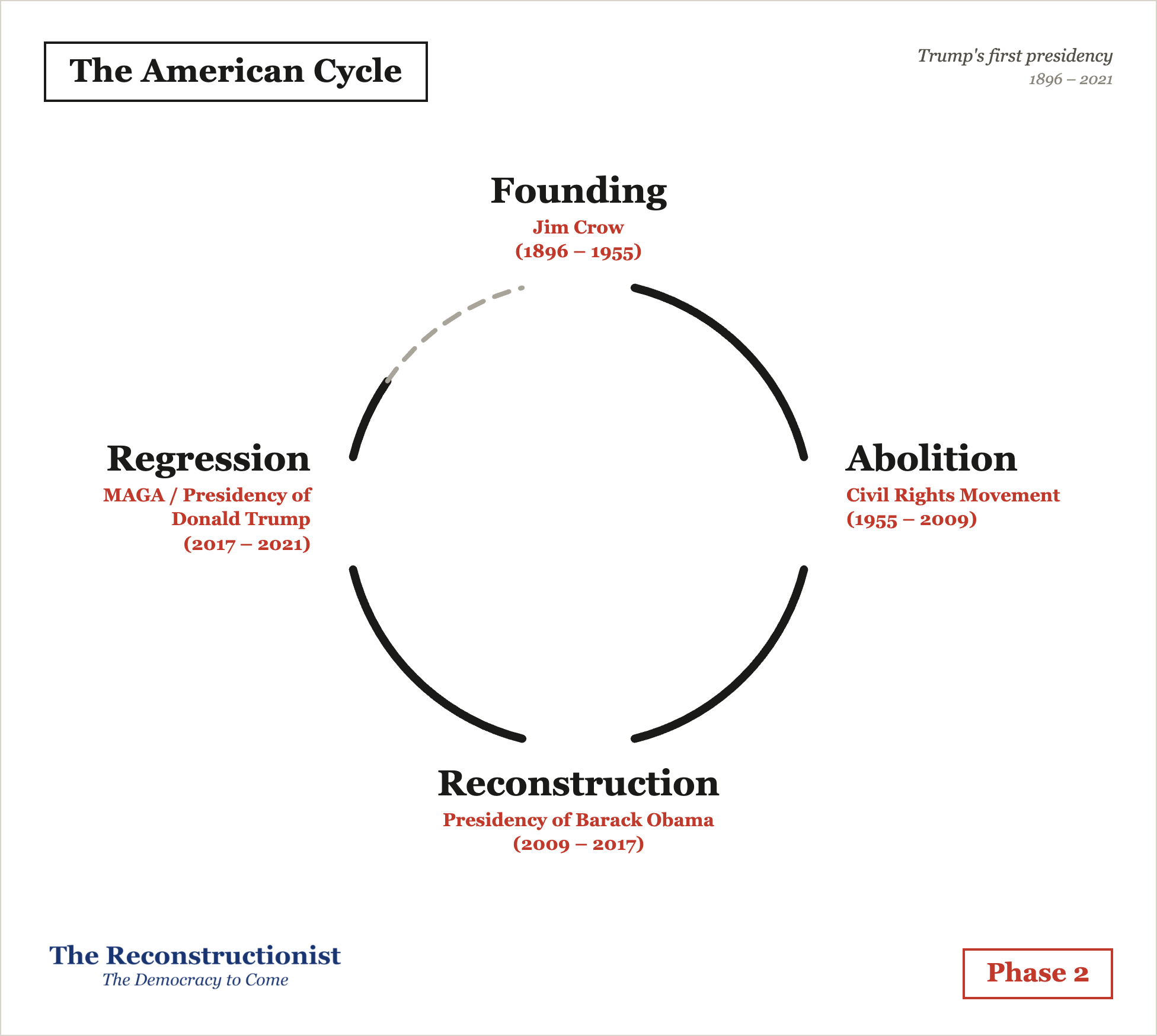
Biden’s Presidency: America’s False Return of Reconstruction (Phase 2)
Biden’s attempt at continuing America’s second Reconstruction was doomed from the beginning because it lacked both the spirit and the explicit language of Reconstruction.
During Obama’s presidency, neither Obama nor the Democrat Party recognized that America was in the midst of a second Reconstruction, and this lack of awareness was evident in their language and agenda. However, as a Black man, Obama’s presence equated to a manifestation of Reconstruction, and allowed for the spirit of Reconstruction to exist throughout his presidency. The racial empowerment of Reconstruction and Obama allowed him to sustain the unique electorate that ensured his victories in 2008 and 2012. Hillary Clinton could not sustain this electorate in 2016, but Biden needed it to win in 2020.
Biden, as a white man in his 70s, could not invoke the same spirit of Reconstruction as Obama could, so for America’s second Reconstruction to thrive, he needed to make up for this deficit with his policy and language. There is a tragic irony about Biden’s inability to invoke the spirit of Reconstruction because Reconstruction would have been impossible without the efforts of white male politicians who passed the laws, amended the Constitution, and championed civil rights. Tragically, America has spent more than a century working to erase these pivotal figures such as John Bingham, Thaddeus Stevens, Charles Sumner, and Albion Tourgée; and as a result, white Americans will celebrate the ideals of less progressive eras of America’s past.
Biden’s task was incredibly difficult because the Democrat Party had little to no interest in Reconstruction, and he faced a committed opposition party, which was not the case during the first half of America’s first Reconstruction. Biden won the presidency because the American public viewed him as an extension of Obama, but as president this proved to be an impossible task.
Despite campaigning as an extension of the Obama presidency, Biden’s political expertise was built in the 1980s and 1990s. In 1971, at the age of 29, Biden became a senator from Delaware, and he held that position until he became vice president in 2009. Biden might have won the presidency due to his affiliation with Obama, but his presidency was defined by his decades of experience serving in Congress. Biden was confident that his experience and capacity to work across the aisle and find common ground with Republicans could help him pass legislation and accomplish his goals. Without explicitly saying so, Biden’s bipartisan approach expressed a pre-Obama status quo, and this alienated Biden’s base.
Prior to Obama’s presidency, Black voter turnout was not significant enough that it could determine the presidency, and it was inconceivable that someone could become president while losing the white vote by 12 points. Once the white voters no longer determined the presidency, bipartisanship effectively disappeared during Obama’s presidency. Biden’s emphasis on bipartisanship harkened back to the Democrat politics of the 1990s and legislation such as the 1994 Crime Bill that Biden co-authored. The Crime Bill helped to usher in America’s expansion of mass incarceration which has disproportionately harmed communities of color. Democrat voters in 2020 wanted the version of Biden from the 2010s, and not the version of Biden from the 1990s.
Biden’s support of Israel also alienated younger voters and voters of color. In the 1990s, America’s support for Israel was absolute, but Obama and Benjamin Netanyahu had a contentious relationship throughout his presidency. Following the October 7, 2023 attack in Israel and Israel’s subsequent response against Palestine, the Democrat Party’s policy regarding Israel became a pivotal topic during the 2024 presidential race. Younger voters and voters of color objected to Biden and the Democrat Party’s support of Israel, and this further eroded the electorate the Democrats needed to win the 2024 presidential election.
Lastly, Biden’s age became a defining feature of his re-election campaign with many voters wanting him to drop out of the race. Following a disastrous debate performance and growing pressure, Biden eventually dropped out of the race on July 21, 2024. Kamala Harris then became the Democrat Party’s nominee, yet her truncated election was unsuccessful and Trump reclaimed the White House in 2025.
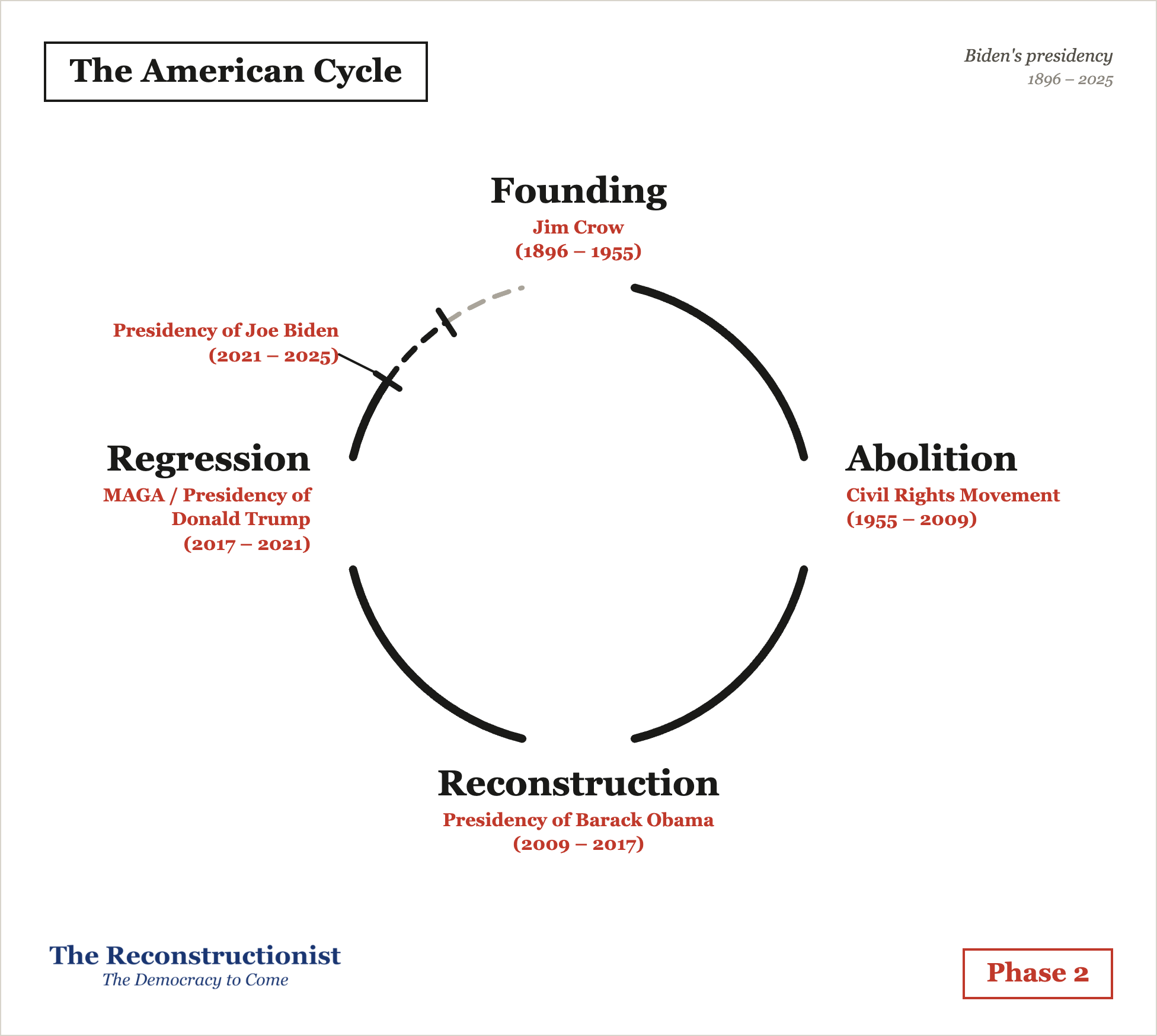
Trump’s Second Presidency: America’s Second Regression Continued (Phase 2)
Trump’s second presidency has been a continuation of his MAGA agenda, and Trump’s circle of advisors spent much of Biden’s presidency assessing their mistakes from the first and creating a more aggressive strategy for the second. The Heritage Foundation’s Project 2025 is a clear example of the right’s four years of planning during Biden’s presidency.
Trump’s immigration policy in his second presidency has been much more aggressive than his first. The Trump Administration’s deployment and expansion of Immigration and Customs Enforcement (ICE) has far exceeded any of his actions during his first presidency. ICE has created large detention centers to house the immigrants that they have detained, and ICE has been allowed to use lethal force. Trump’s ICE agenda has targeted not just undocumented immigrants, but also almost anyone going through the immigration process who may be pursuing a visa or green card. The aggressive targeting of immigrants from Latin America and Africa has added a racial component to Trump’s immigration agenda, and it has drawn comparisons to the Fugitive Slave Act of 1850. Again this is another example of how MAGA embraces the ideals of pre-Reconstruction America.
Trump’s second presidency has also targeted one of the premier accomplishments of Reconstruction: the birthright citizenship provision of 14th Amendment. As part of their immigration policy, the Trump Administration has sought to end birthright citizenship and their case went all the way to the Supreme Court. In Trump v. Barbara, in a 6-3 ruling, the Supreme Court upheld the constitutionality of birthright citizenship, but it should alarm all Americans that three Supreme Court Justices believe that part of the Constitution is unconstitutional. This is another attack on Reconstruction and it echoes the Redeemer agenda of the late 1800s.
The Trump Administration has also waged a culture war that consists of attacking diversity, equity, and inclusion (DEI) initiatives; erasing history that is not complimentary to white Americans; and presenting a “patriotic” approach to American history that celebrates white Americans–including Confederates. This is a modern-day application of the Lost Cause of the Confederacy.
Lastly, throughout Trump’s presidencies he has worked to undermine the legitimacy of American elections. When he lost to Biden in 2020, he claimed that the election was stolen and he still maintains that claim. Throughout 2026, Trump has also insinuated that he may interfere in the midterm elections to help ensure that the Republican Party maintains control of Congress. And despite already winning the presidency twice Trump has repeatedly indicated that he may violate the Twenty-Second Amendment and run for the presidency for a third time. Manipulating elections, undermining the Constitution, and never relinquishing power were key components of the Redeemer agenda during and after Reconstruction, and Trump remains an extension of this playbook except he is applying this regressive agenda at a national and not a regional level.
If America’s second Regression era succeeds, the United States will create a third Founding era—or a second Jim Crow—defined by ethnocide, racial division, and authoritarianism. After Reconstruction ended in 1877 it took more than 130 years for America to recommence Reconstruction during Obama’s presidency, so if the American Cycle continues and the third Founding era begins it could be another 130 years before Reconstruction recommences for the third time. If we do not break the American Cycle, America’s third Reconstruction may not occur until 2150.
If we want to save multiracial democracy in America, we must break the American Cycle. Reconstructionism exists to continue Reconstruction and break the American Cycle.