

I have been thinking about the American Cycle since 2016 when I noticed that the end of Barack Obama’s presidency mirrored the end of Reconstruction, and over the next decade the American Cycle has become an integral component of my work and Reconstructionism.
In The Crime Without a Name: Ethnocide and the Erasure of Culture in America, I dedicated a chapter—Chapter 9: The Language of American Fascism—to the American Cycle, yet over the last ten years, I do not believe that it has gotten the recognition that it deserves. When I talk to people about Reconstructionism, the American Cycle is one of the first things that I mention, yet on The Reconstructionist I don’t believe that I’ve given it the same attention as when I talk with people directly. The American Cycle has thus far resided in the background as it has quietly shaped my work, but now is the moment for it to live in the foreground.
For ten years, the American Cycle has remained a controversial and contentious theory with those who I have shared it with because the theory shows that the United States is far more likely to regress into division and terror than progress into unity and civility. The American Cycle flies in the face of what we have been told about America, but as it becomes more accurate with each passing day, we all need to recognize the urgency of breaking the American Cycle. Reconstructionism exists to break the Cycle and Reconstructionist are committed to breaking the Cycle and forging a better America.
Back in 2016, when I first started noticing the Cycle my focus was primarily on the political dynamics and demographics of the 2016 presidential race and the alarming similarities between them and the presidential election of 1876.
I could see how Donald Trump had a pathway to victory and how Hillary Clinton may struggle to maintain the Obama electorate. I believed it was a slim chance, but I saw the path and it echoed the end of Reconstruction. Essentially, Black voter turnout drops for Democrats, and the Republicans stoke racial division and appeal to lower income and lower educated white voters by promising economic empowerment. Conservatives also needed to spew rhetoric that harkened back to a more idyllic and patriotic time that preceded the area of multiracial democracy implemented during Reconstruction and Obama’s presidency.
In 1876, the Democrat Party—who objected to Reconstruction—implemented a similar strategy as Trump in 2016. In 1876, the Democrats used the terror of white supremacist militias such as the Ku Klu Klan to suppress Black voter turnout, proclaimed themselves as a populist party for white Americans, and even called themselves “Redeemers” because they wanted to redeem the South by returning it to a pre-Civil War status quo. This is the same rhetoric as Trump’s “Make America Great Again.”
In 1876, the Democrat’s successful strategy resulted in multiple Southern states not being able to certify their election results. Therefore, neither Republican candidate Rutherford B. Hayes or Democrat candidate Samuel Tilden could be declared president. Eventually, a compromise was made and Hayes become president, but federal troops were removed from the South. The Democrats lost the presidency in 1876, but succeeded in their primary objective of reclaiming control of the South.
In 2016, Trump won the presidency, and now the ideology of the destroyers of Reconstruction became the agenda of the Trump presidency.
After Trump’s victory in 2016, I expected his presidency to mirror post-Reconstruction America, and when it did, I now had further confirmation on the accuracy of my theory of the American Cycle.
To understand America, and our future, we must understand the American Cycle.
Introduction to the The American Cycle
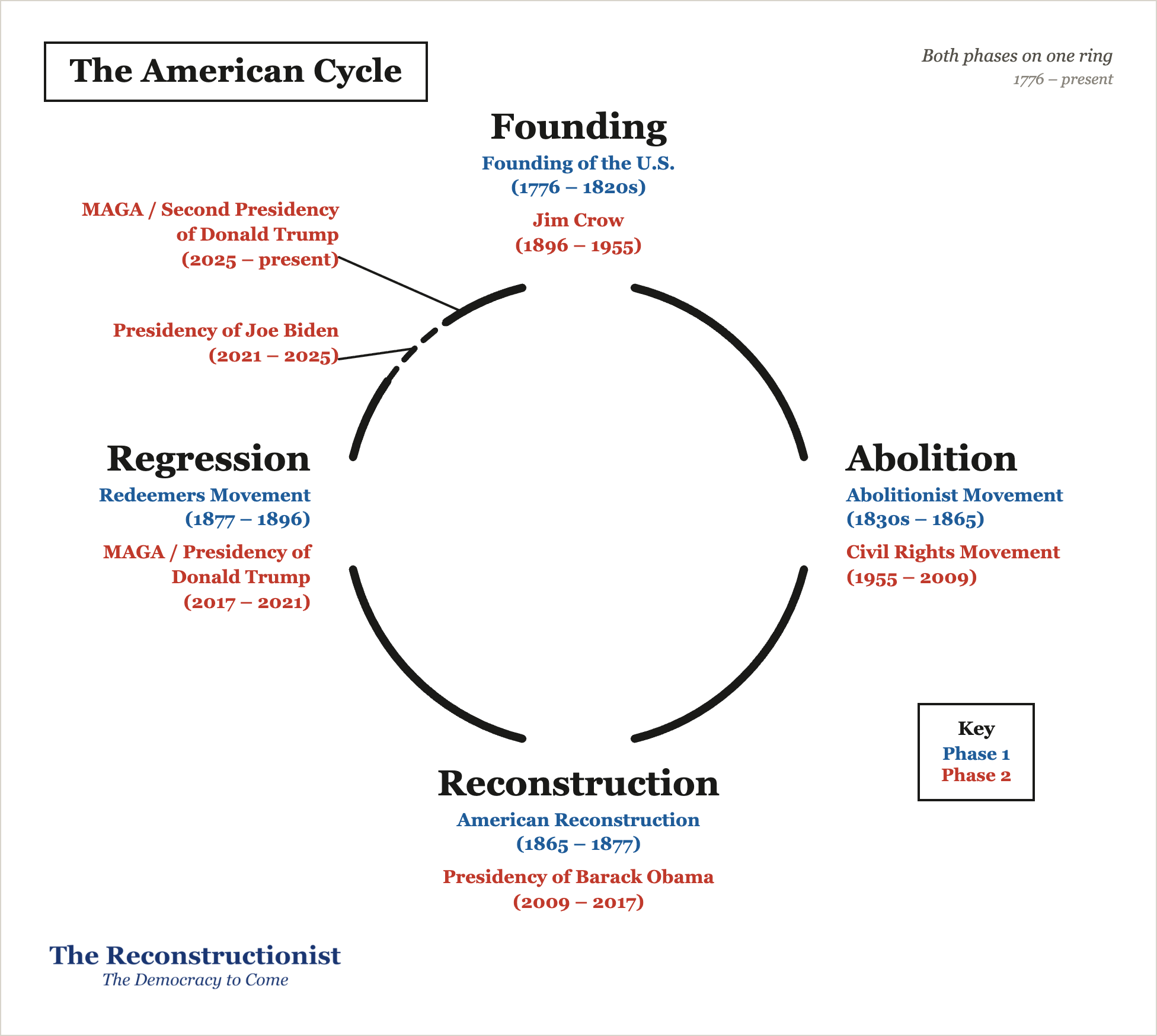
Over the past 250 years, the United States has completed the American Cycle almost twice and is on the cusp of starting a third. To preserve our democracy, we need to break the Cycle once-and-for-all.
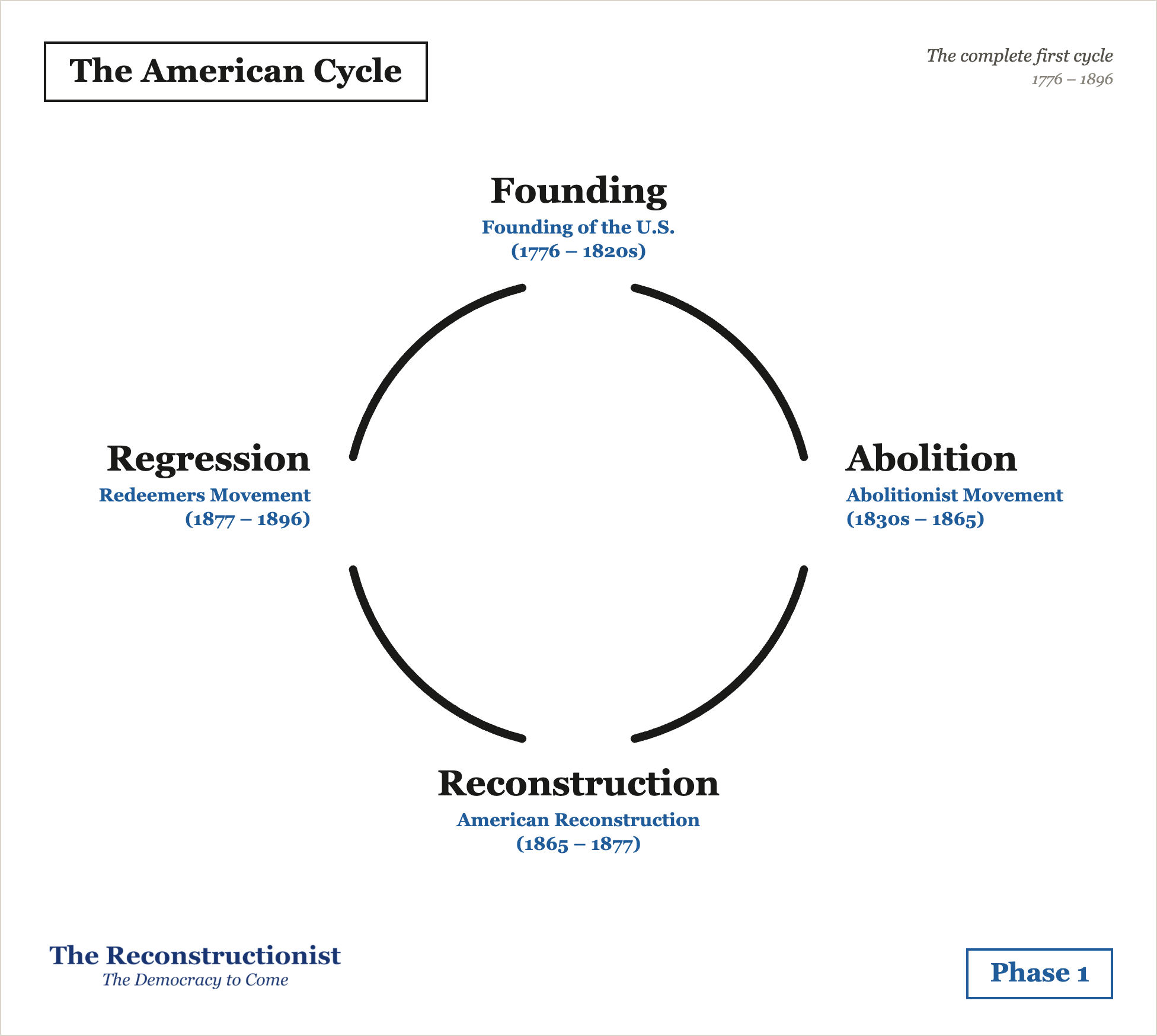
The American Cycle consists of four stages: Founding, Abolition, Reconstruction, and Regression.
Below, you’ll see a description of the American Cycle and its two phases.
Founding Era (Phase 1)
The Founding stage, starts with the founding of the United States by way of the Declaration of Independence and runs until the 1830s and the birth of the Abolitionist movement. The Founding era is defined by the United States’ desire to construct a democracy with ethnocide.
In my book, The Crime Without a Name: Ethnocide and the Erasure of Culture in America, I detail ethnocide’s influence on the United States. Ethnocide is the destruction of a people’s culture while keeping the people, and in my book, I use the term ethnocide to describe the transatlantic slave trade because it was a multi-century campaign to keep African people while destroying their cultures.
Cultural destruction was a key part of the slave trade because a shared culture would have made it easier for enslaved people to rebel and liberate themselves from slavery. Cultural destruction was therefore a defining feature of the slave trade and American slavery. European slave traders and colonizers intentionally and systematically prevented African people from continuing their cultural practices. They broke up families and separated Africans who spoke the same language. Culture and language gave people meaning, so ethnocide attempted to make life nearly meaningless. Ethnocide meant to crush the spirit of African people because spiritless people are less likely to rebel. Cultural destruction thus defined chattel slavery in America.
Greed and wealth accumulation were the primary motivators of the slave trade. Colonizers and colonists actively destroyed the lives and cultures of African people because they believed that they could make money from the destruction. The normalization of greed, dehumanization, and systemic destruction are also key features of the Founding era.
Therefore, the creation of an American democracy that legalized slavery was the creation of a democracy with ethnocide.
Due to the contradiction of having a democracy with legalized chattel slavery, the Founding era is also defined by attempts to obfuscate slavery while strengthening the power of pro-slavery voices. Had the United States’ democracy proudly proclaimed and explicitly stated its embrace of slavery, then our democracy could never have been perceived as legitimate. Accordingly, much of the text of this era is inherently dishonest.
The U.S. Constitution does not mention slavery, but it does include the three-fifths compromise, the Electoral College, and its property protections in the Fourth and Fifth Amendments were understood to categorize enslaved people as the property of their owner.
The three-fifths compromise counted enslaved people as three-fifths of a person regarding congressional apportionment and Electoral College votes, so despite not mentioning slavery, the U.S. Constitution granted slave owning states additional representation in the House of Representatives based on the number of slaves in each state. Also, a state’s Electoral College votes were determined by their congressional representation in the House and the Senate. The larger the enslaved population in a state, the greater the influence in America’s democracy. It is not a coincidence that prior to the abolition of slavery that the majority of America’s presidents were slave owners from the South.
The foundational hypocrisy and corruption of this era mean that it was inevitable that it would implode. The pro-democracy and pro-slavery factions will fight to end the hypocrisy and reshape America according to their respective ideals. The pro-slavery faction will attempt to remove the democratic facade once it becomes an impediment and no longer an asset to their pro-slavery agenda, and the pro-democracy faction will attempt to abolish slavery and ensure that America’s pro-democracy language is no longer used to legitimize slavery and instead legitimizes democracy.
Abolition Era (Phase 1)
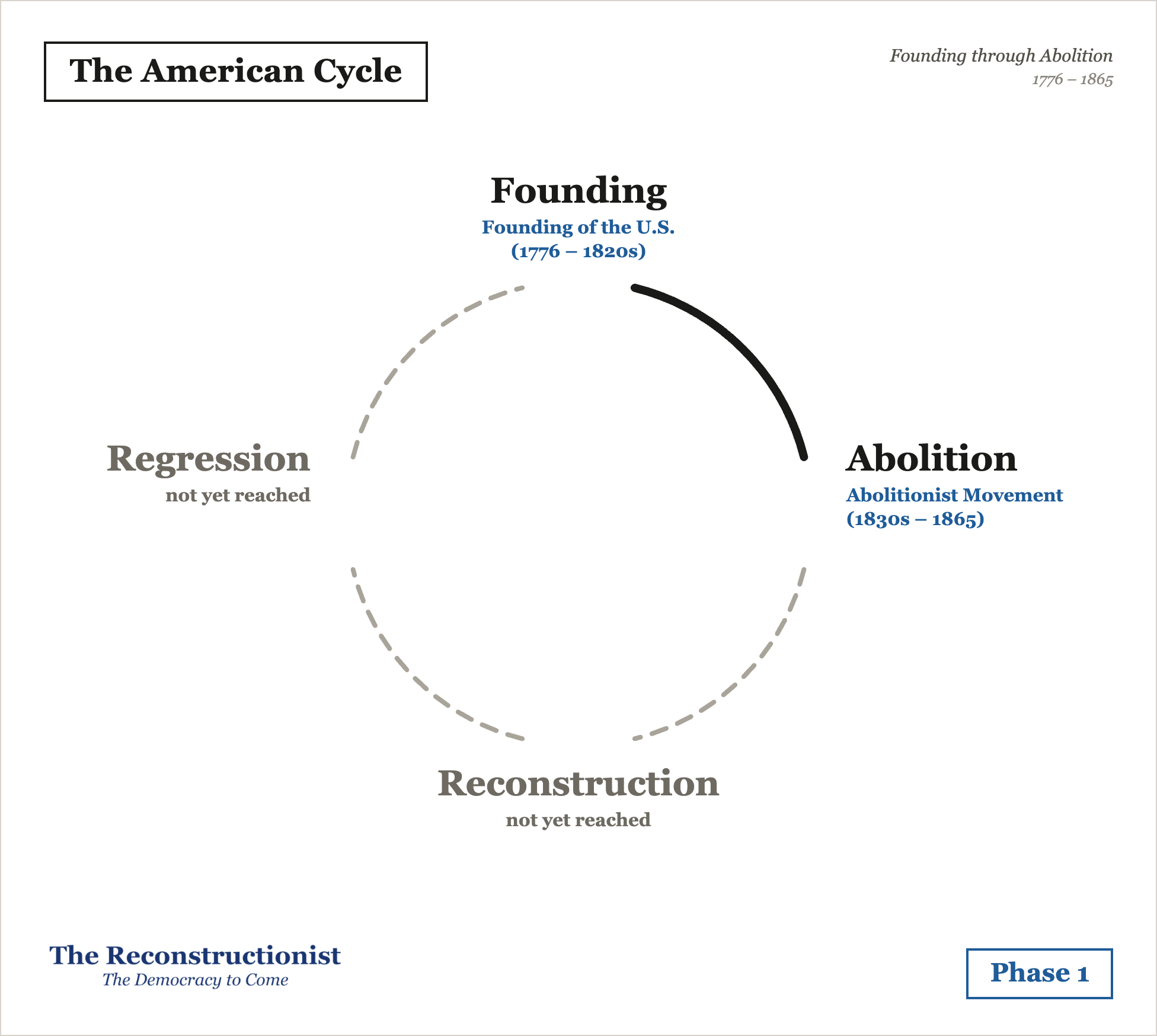
The second stage is the Abolition era and this runs from the 1830s to the end of the Civil War in 1865. In this stage, a national movement forms in the United States to abolish ethnocide, which at this time was slavery.
In 1831 William Lloyd Garrison first published his abolitionist publication The Liberator and in that same year, Nat Turner attempted the largest slave rebellion in American history. In 1839, the Spanish slave ship La Amistad arrived in New England carrying approximately 50 Mende Africans who had overthrown their captors and seized control of the ship. Former president John Quincy Adams argued on the behalf of the Mende Africans before the Supreme Court in United States v. The Amistad and in 1841, the Court sided in their favor and agreed to free the Africans and not return them to Spanish authorities. The case of La Amistad, which means “The Friendship” in Spanish, was a pivotal event in the early stages of the Abolitionist movement.
A key aspect of this stage is that a significant segment of white Americans have chosen to become a part of the movement to abolish slavery. The inclusion of white voices represents a quasi-tipping point where the fight for Black liberation is no longer considered an exclusively Black endeavor. A former president espousing abolitionist ideals and arguing on behalf of Black people before the Supreme Court was a tipping point moment.
Black people have always fought to abolish their enslavement (as the Mende people did on La Amistad), but American history books do not proclaim that the abolition movement started when the first Africans attempted to liberate themselves from enslavement. The Underground Railroad existed since the dawn of the United States, but the beginning of the Underground Railroad, despite abolishing Black enslavement one person at a time, has never been described as the beginning of the Abolitionist movement. Black people’s refusal to allow ethnocide to destroy their spirit, and the recognition of Black existence and spirit by white Americans, fuels what American historians call the Abolitionist movement that started in the 1830s.
Another key feature of this era was how abolitionism reshaped American politics. America’s bipartisan political system was born during this era.
In 1833, the Whig Party was formed to counter the authoritarianism and American Populism of President Andrew Jackson and his Democrat Party, but the Whig Party disappeared in 1856 because they could not agree on a unified position regarding the expansion of slavery. The Republican Party filled the void left by the Whigs and the battle between Democrats and Republicans has defined American politics ever since.
The Whigs existed as an oppositional party. You were for the Whigs if you were against Jacksonian Democracy. Despite existing for only 23 years, the Whigs succeeded in having four American presidents, and created America’s two party system. For two decades, the Democrats and the Whigs dominated American politics.
But the Whigs’ inability to oppose slavery and the authoritarianism created by pro-slavery politicians such as Andrew Jackson meant that their decline was inevitable. Outside of John Adams and his son John Quincy Adams every American president was effectively pro-slavery, so unilaterally opposing slavery seemed like a step too far for the Whigs.
Following the passage of the Fugitive Slave Act in 1850, many northern voters joined the abolitionist movement and left the Whig Party. Allowing Southern bounty hunters and slave catchers to invade the North gave northerners their first taste of the realities of slavery in America, and their outrage fueled the abolitionist movement in the 1850s. Harriet Beecher Stowe’s Uncle Tom’s Cabin was published in 1852 and gave northern readers a literary depiction of the brutality of slavery in the South. The book became the most popular novel in America. The Supreme Court’s decision in Dred Scott v. Sandford in 1857 added additional fuel to the fire of the northern abolitionist movement.
The abolitionist movement grew rapidly in the North in the 1850s and eventually the abolitionist Republican Party was created in 1854. Initially, the Republican Party focused on abolishing the expansion of slavery into the North and U.S. territories, but eventually, their platform advocated for the abolition of slavery in the United States. On January 1, 1863, Republican President Abraham Lincoln issued the Emancipation Proclamation.
In six years, the Republican Party transformed from being a collection of northern abolitionist upstarts to winning the presidency with a candidate who had almost no national political experience. Prior to becoming president, Lincoln had only served one term in the House of Representatives as a member of the Whig Party from 1847 to 1849, and four terms in the Illinois State Legislature representing Sangamon County in central Illinois.
Two years after the Republican Party was formed, the Whig Party collapsed because American voters wanted a party that was for the abolition of slavery and not merely against the principles of Andrew Jackson.
The reality of a Republican president alarmed the Southern Democrats and the prospect of the abolition of slavery frightened and outraged Democrats to such an extent that they launched the American Civil War in 1861. Southern Democrats then decided to secede from the Union and form the Confederacy, and in their constitution they explicitly used the term “slavery” and championed white supremacy.
In 1865, the Union and the Republican Party prevailed over the Confederacy and the Democrats, and now American Reconstruction could begin. Yet, despite losing the war, the former Confederates refused to give up the fight.
On April 9, 1865, Confederate General Robert E. Lee surrendered to Union General Ulysses S. Grant at Appomattox Court House, and less than a week later on April 15, 1865, Confederate sympathizer John Wilkes Booth assassinated Lincoln at Ford’s Theatre.
The success of the Abolition era creates the third stage of the American Cycle, yet America’s regressive forces will also spend this era attempting to destroy Reconstruction.
Reconstruction Era (Phase 1)
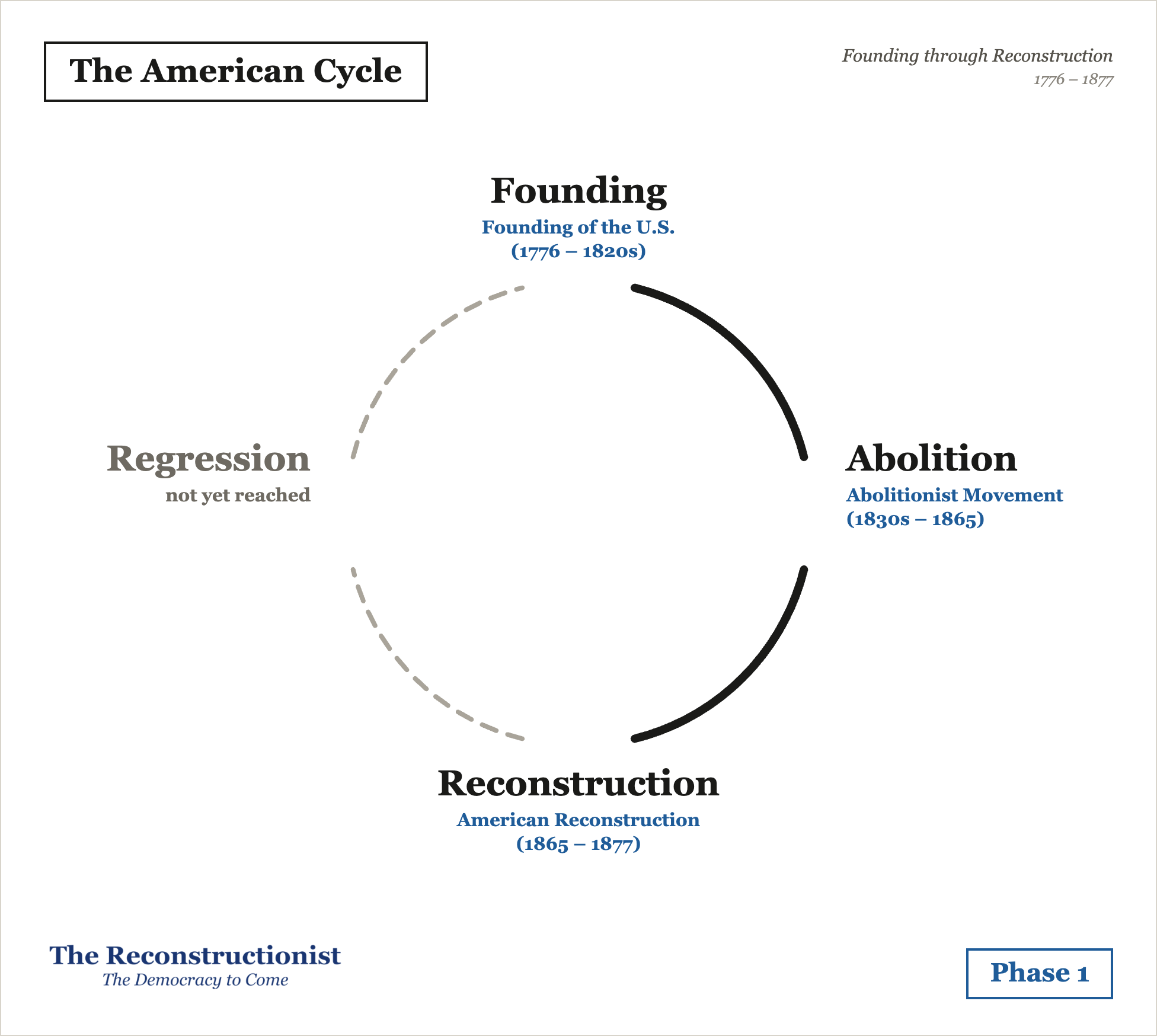
American Reconstruction from 1865 to 1877 is the time when the United States attempted to reconstruct American democracy and society into one without ethnocide, and in so doing, it became obvious that abolishing slavery was not enough. The reach of slavery and ethnocide had corrupted the entirety of the United States’ democracy, so the removal of the corruption required a complete reconstruction of our democracy.
Lincoln’s Emancipation Proclamation on January 1, 1863, was a precursor to the progress to come. In 1865, the Thirteenth Amendment abolished slavery at the constitutional level, and the Civil Rights Act of 1866 birthed civil rights (and human rights) in America, but the Fourteenth Amendment in 1868 commenced the radical reconstruction of the U.S. Constitution.
The Fourteenth Amendment established birthright citizenship, and equal protection and due process under law for all Americans. Prior to the Fourteenth Amendment, human equality played no part in the Constitution, and inequality–especially racial inequality–remained a foundational pillar of American democracy.
Additionally, the Fourteenth Amendment ensured that the Bill of Rights was federally enforceable and not determined by the states. Prior to 1868, an American’s freedom of speech was determined by the state they resided in and one’s freedoms could radically change when crossing state lines. Essentially, almost all of our freedoms were determined at the state level before Reconstruction. The Bill of Rights as we know it today did not exist before Reconstruction. In fact, the term “Bill of Rights” to refer to our founding ten amendments was coined by John Bingham, the primary author of the Fourteenth Amendment. In more ways than one, Reconstruction created the Bill of Rights and made it integral to our democracy.
The Fifteenth Amendment that extended voting rights to Black men, which was originally intended as part of the Fourteenth Amendment, was passed in 1870. Soon thereafter President Ulysses S. Grant created the Department of Justice to ensure that the civil rights of all Americans were protected.
Also, starting in the 1870s the Republican Party began calling itself the “Grand Old Party” in recognition of preserving the Union and implementing Reconstruction.
Reconstruction birthed multiracial democracy in the United States.
Unsurprisingly, the former Confederates in the South viewed Reconstruction as an attack on their white supremacist ideals and their way of life, and they fought to destroy Reconstruction since its inception. The traditional warfare of the Civil War was replaced with guerilla tactics and legislative warfare.
Lincoln’s successor Andrew Johnson was a pro-Union sympathizer from Tennessee but he was not in favor of the Republican Party’s Reconstruction agenda. He vetoed the Civil Rights Act of 1866 and the Freedmen’s Bureau, and proclaimed that they were racist against white Americans. Johnson also pardoned the former Confederate soldiers and most of the Confederate leadership. Johnson’s commitment to obstruct Reconstruction was so unwavering that his own party impeached him, but did not have the votes to remove him from office. In 1868, Johnson ran for the presidency as a Democrat, but failed to win the party’s nomination.
Johnson was president for less than four years, but his work to undermine Reconstruction was profound. The pardoned Confederates quickly formed racist militias such as the Ku Klux Klan to help win back political support for Democrat politicians in the South. During Reconstruction, the KKK was the de facto military wing of the Democrat Party. The KKK was never just a random assemblage white supremacists who terrorized Black Americans merely for the sake of inflicting terror. The KKK terrorized Black Americans, and their white allies, for the explicit purpose of helping the Democrat Party reclaim political control of the South. Following the passage of the Fifteenth Amendment in 1870, terrorism and voter suppression were interwoven agendas for the KKK. From Reconstruction’s inception and especially from 1870 to Reconstruction’s collapse in 1877, white supremacist terror in support of a racist political agenda remained an ever-present reality of Reconstruction.
The Southerners who opposed Reconstruction, not only created terrorist militias, but also created a political movement that collaborated with the militias. Southern Democrats began calling themselves “Redeemers” during Reconstruction, and their agenda was to “redeem” the South by returning it to a pre-Civil War status quo. The KKK and other white terrorist militias would murder, terrorize, and suppress the vote of Republicans, and then a Redeemer Democrat would win the election and start rolling back the progress of Reconstruction.
In 1874, Democrats in Louisiana attempted a coup d’etat following John McEnery’s defeat to Republican William Kellogg in the gubernatorial elections. To stop the coup, President Grant sent down the military to defeat McEnery’s supporters who were a combination of Redeemer Democrats and white supremacist militias including the White League.
The failed coup d’etat was the culmination of a multi-year terrorist campaign by McEnery’s supporters that they had been waging since the disputed election results in 1872.
Prior to the attempted coup, McEnery’s supporters committed “the bloodiest single instance of racial carnage in the Reconstruction Era.” On April 13, 1873, they committed the Colfax Massacre and it is estimated that over 150 Black Americans and three white Americans died in this massacre, but the exact numbers are unknown because McEnery’s supporters threw many of the bodies into the Red River and placed the others in a large, unmarked mass grave.
In response to the Colfax Massacre, countless other instances of racist and anti-democratic terror, and the failed coup d’etat, the federal government kept a sustained military presence in the South for the remainder of Reconstruction.
The violent partnership of Redeemer Democrats and white supremacist militias is how the traditional warfare of the Union vs. the Confederacy transitioned into an agenda of guerilla and legislative warfare waged by Redeemers and white supremacist militias.
Unsurprisingly, the term “white supremacy” became a key part of the American lexicon during Reconstruction, but in the 1860s, “white supremacy” was almost exclusively used by racist white Americans to describe what they believed was the natural order of race relations. In 1868 — the same year as the ratification of the Fourteenth Amendment — Dr. John H. Van Evrie published White Supremacy and Negro Subordination; or, Negroes a Subordinate Race, and (so called) Slavery Its Normal Condition, and his book is the first published reference to the term “white supremacy” in America. During Reconstruction, white Southerners would proudly proclaim themselves to be white supremacists. According to Van Evrie and the countless white Americans who supported his beliefs and adopted his terminology, white supremacy was not a toxic offshoot of white culture and white identity, but instead was the defining characteristic of whiteness in America. Whiteness was incompatible with equality, which meant that whiteness was incompatible with Reconstruction, so “redeeming” the South and returning society back to the inequality prior to Reconstruction was the only way that white culture and identity could survive.
By 1876, the unrelenting terrorism of Redeemer Democrats and their white supremacist militias had effectively made democracy untenable in the South, and as a result, it became impossible to accurately count votes and determine who would win the presidential election of 1876. Most of the election results in the South remained disputed after election day, and it was unclear if Republican Rutherford B. Hayes or Democrat Samuel Tilden had obtained enough electoral college votes to be declared the victor. To resolve this dispute, a committee was formed to determine our next president and eventually a deal was struck that would allow Hayes to become president, so long as the federal government removed their military presence from the South. Without the military protection of the federal government, Black Americans and white Republicans in the South had little to no means for combating white supremacist terror. White terrorism ended Reconstruction and democracy in the South.
The South might have lost the presidential election of 1876, but they accomplished their main goal of ending Reconstruction. Reconstruction effectively ended in 1877 with the presidency of Rutherford B. Hayes and the removal of federal troops from the South.
Regression (Phase 1)
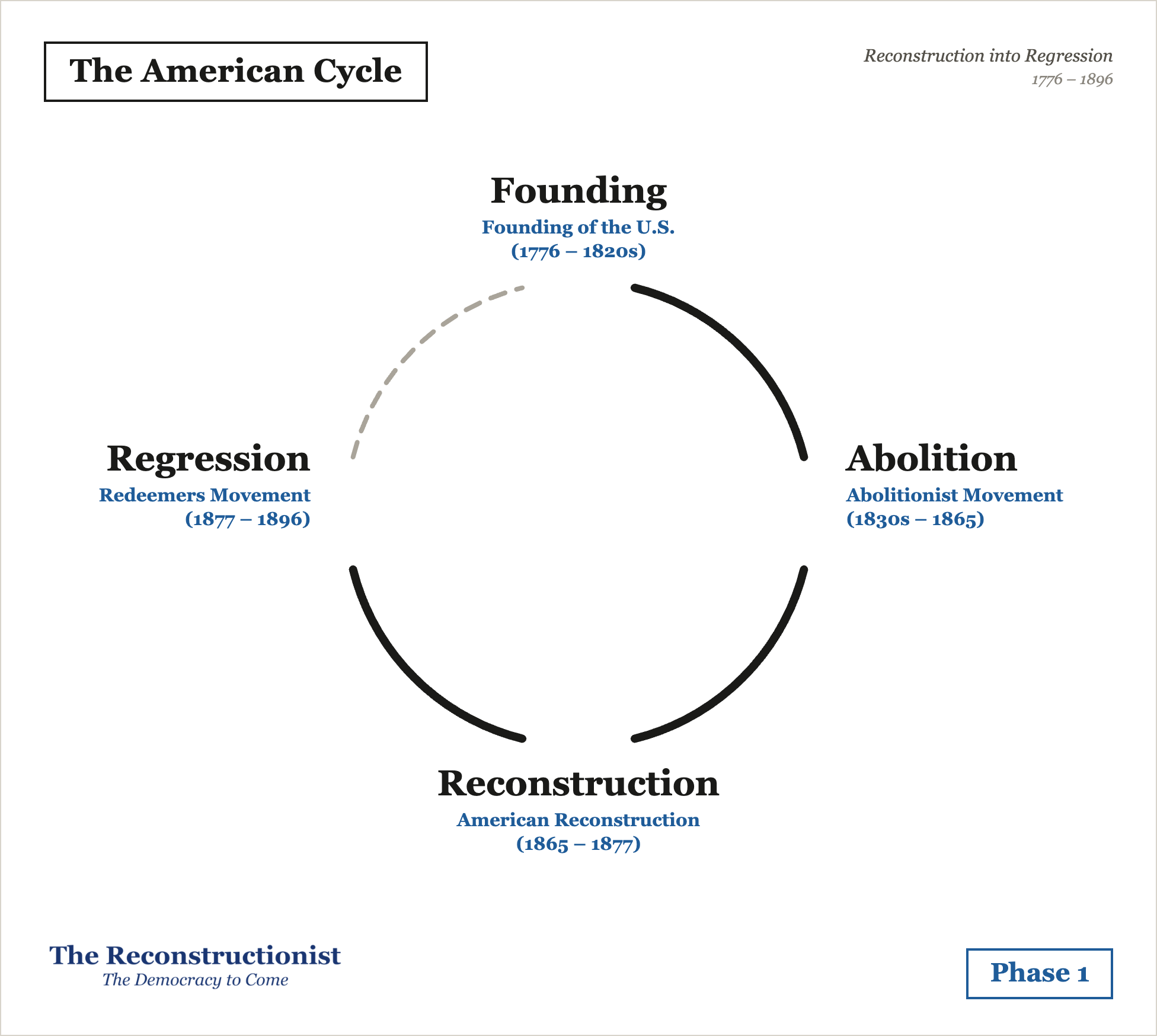
Following Reconstruction’s collapse, the Redeemer Democrats retook control of the South and began implementing their plan to erase the progress of Reconstruction. The racist, white supremacist Southerners called the post-Reconstruction era, the era of “Redemption” because they had finally reclaimed the political authority to “redeem” the South by returning it to a way of life akin to their pre-Civil War status quo, but for all Americans who care about democracy and equality, this era should be known as the era of Regression.
The era of Regression culminated in Plessy v. Ferguson in 1896. The Regression era worked to bring back ethnocidal division into American society and government, and the legalization of separate but equal launched a second Founding Era in America known as Jim Crow. Regression is the last stage in the American Cycle before it starts anew with a “democracy” founded upon division and inequality.
From 1877 to 1896, the Redeemers engaged in not just guerilla and legislative warfare, but also cultural and narrative warfare. One of the biggest aspects of this era was the South’s campaign to remake the story of Reconstruction and the Civil War to paint the South as the heroes and Reconstruction as a failure. The agenda to repaint the South as heroes became known as the Lost Cause of the Confederacy, and throughout the South monuments and memorials were erected to celebrate fallen Confederates and members of white terrorist militias.
In 1891, a monument was erected in New Orleans called The Battle of Liberty Place that celebrated the supporters of Democrat gubernatorial candidate John McEnery who attempted the 1874 coup d’etat in New Orleans and had waged a reign of terror leading up to the attack. The monument celebrating these terrorists lived in the heart of New Orleans until 2017 until it was taken down by Democrat Governor Mitch Landrieu.
This campaign continued well into the 20th century as the Daughters of the Confederacy proclaimed the narrative of the Lost Cause and the Dunning School described the failures of Reconstruction as being the result of Republican and Black American incompetence instead of a sustained campaign of white supremacist terrorism. The impacts of this narrative still reverberate today as many Americans remain ill-informed about the authentic story of Reconstruction.
The role of language and narrative are especially important in this era because not only did the South need to create a new narrative that depicted traitorous Southerners as heroes, but also because the progress of Reconstruction meant that they could no longer rely on explicitly racist language to implement their racist agenda. The language of poll taxes, literacy exams, vagrancy laws and separate but equal became the norm of this era. Race neutral language became the new means for creating racist outcomes. Much like the Founding Era, language during the Regression Era is often used to obfuscate the intent of their anti-democratic, racist agenda.
Post-Reconstruction, the United States appeared to be race neutral based upon the language used by both Democrats and Republicans. For the Democrats, the appearance of neutrality existed primarily as a means for fueling a racist agenda, but for the Republicans, racial neutrality gave them the opportunity to shift their focus away from racial equality and toward matters of business and industrialization. American industrialization grew in that latter half of the 19th century, and Republican businessmen had grown tired of the costs related to sustaining Reconstruction. The incessant terror inflicted by white terrorists militias in the South meant that maintaining Reconstruction became an expensive endeavor and it also prevented Republican businessmen from expanding their businesses into the South. The appointment of Rutherford B. Hayes to the presidency and the removal of federal troops from the South effectively ended Reconstruction and opened the South up to northern businesses and investment.
The Republican Party post-Reconstruction argued that Reconstruction had already done enough to create equality in the United States, and now their attention could shift towards business and economic issues. This shift effectively meant that the Democrats no longer had genuine opposition to their racist agenda and this empowered the Democrats to aggressively dismantle Reconstruction.
Additionally, the Republican Party’s emphasis on business and industry helped fuel the Gilded Age and created massive income inequality across the nation. As a result of the large wealth disparities, the American public became more aware of the harsh and deadly labor conditions of many American workers, and especially children. Prior to Reconstruction and the Civil War, America’s most brutal labor conditions were reserved for America’s enslaved population and American industry was built around the expectation of having workers who could work all-day, everyday and without a concern for their well-being. The end of slavery and the progress of Reconstruction meant that brutal labor was no longer the exclusive domain of America’s enslaved population, and now poor whites and immigrant labor were also subjected to inhumane labor conditions. Industrialization and the growth of corporations also impacted white farmers across the South and Midwest, and by the late 1880s a populist movement had emerged to defend the rights of working Americans.
Despite the populist movement being a movement about American workers, it showed very little concern for the rights and labor of Americans of color, and as a result, the Populist Party (founded in 1892 and born from the populist movement) found itself to be more aligned with the Democrat Party, who supposedly represented the people, than the Republican Party, who represented the interests of big business. The Populist Party never managed to challenge the duopoly of the Democrat and Republican parties and it collapsed in 1896. Following its collapse, their former members either joined the Democrat Party or followed socialist Eugene Debs and helped to create the Socialist Party of America in 1901, but they did not join the Republican Party.
By 1896, racial or social equality was no longer a concern of the Democrat or Republican Party, or America’s growing socialist movement. Once racial and social equality became a non-factor in American politics the identities of America’s political parties also changed. The Republican Party which was founded on its opposition to slavery and implemented Reconstruction had become the political party of business and industry, and this identity has stuck with the GOP into the present. Similarly, the Democrat Party’s commitment to “redeeming” the South made them into a party that focused on the interests of white Americans and not corporations. Ironically, their racist agenda turned them into a party that cared about the “people” and not corporations. The Democrat Party of the late 1800s had returned to the populism of Andrew Jackson and the racist origins of its founding.
Lastly, the culmination of Regression was Plessy v. Ferguson that legalized separate but equal.
The lawsuit that prompted Plessy v. Ferguson was created by Le Comité des Citoyens, which was a multiracial civil rights group in New Orleans, that challenged Louisiana’s Separate Car Act that required separate train car accommodations for Black and white passengers. To prevent the demise of Reconstruction a multiracial civil rights group came together to challenge the legality of “separate but equal” that had already been deemed unconstitutional during Reconstruction.
In 1868, a Black woman named Katherine Brown boarded a train in Alexandria, Virginia that was headed to Washington, D.C., but she was forcefully taken off of the train and severely beaten because she allegedly sat in a “Whites Only” train car. Brown, with the support of numerous Republican congressmen, sued the railroad company and in 1873, in Railroad Company v. Brown the Supreme Court sided in favor of Brown. During the case, the railroad company argued that they had not violated their charter because they allegedly supplied “separate but equal” accommodations to Black and white passengers. In 1873, Supreme Court Justice David Davis described the railroad company’s “separate but equal” argument as “an ingenious attempt to evade a compliance with the obvious meaning of the requirement.”
In 1896, Le Comité des Citoyens essentially attempted to prevent the demise of Reconstruction by arguing that what was deemed unconstitutional in 1873 should still be unconstitutional in 1896. The Supreme Court’s decision to legitimize and legalize separate but equal completed the Redeemers agenda and regressed America back to a pre-Reconstruction norm.
Jim Crow, America’s Second Founding, would soon commence and start the American Cycle anew.
Part 2 will be published on Thursday, September 24, 2026