

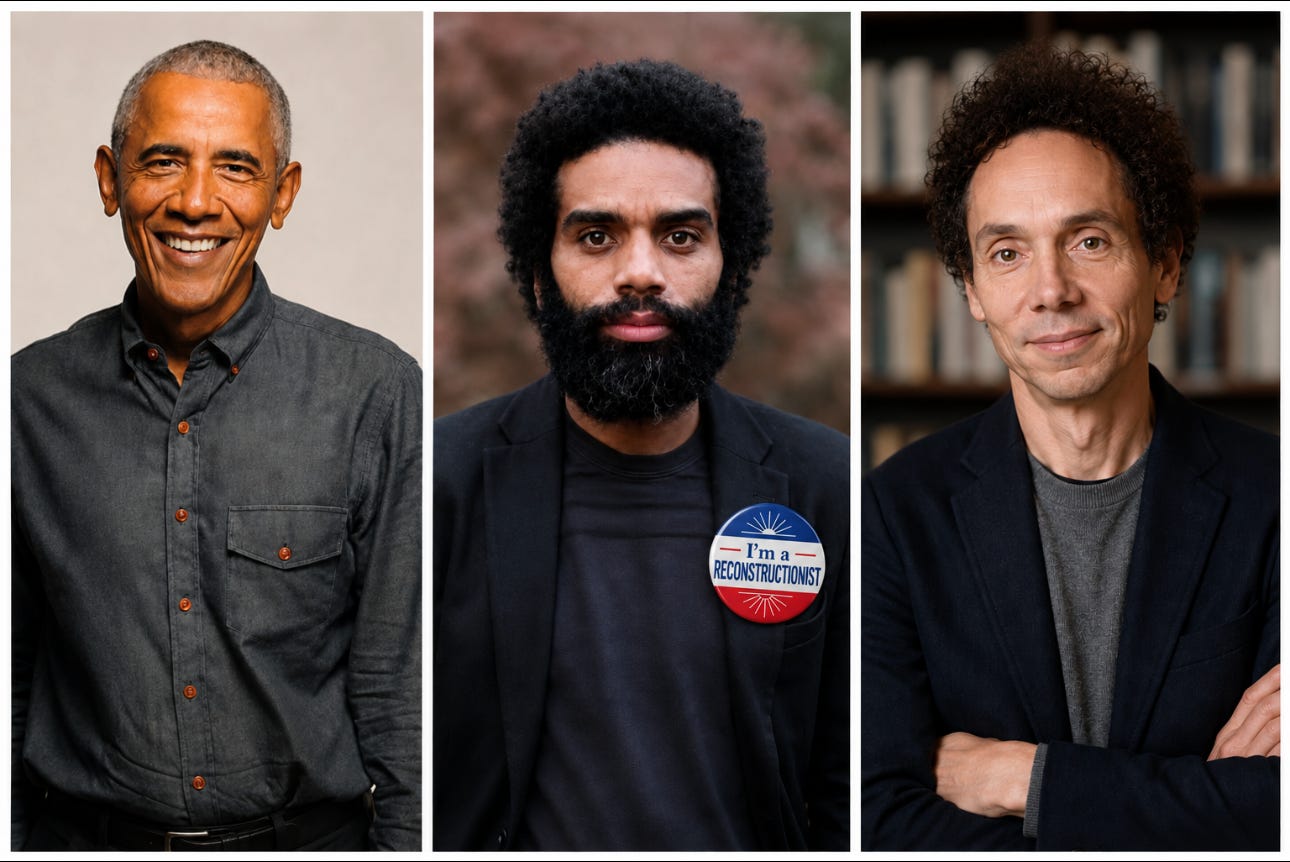
Let’s talk about how cool it is that Malcolm Gladwell, Barack Obama and the History Channel released a podcast this summer about Reconstruction.
Reconstruction: The Unfinished Promise describes itself as an introduction to “one of the most chaotic, complicated, and fascinating times in American history, revealing why Reconstruction still defines our country today.”
As someone who is making the argument that the next Democratic presidential nominee should describe themselves as a Reconstructionist, I found this historic podcast to be a juicy and delicious addition to the big table of Reconstructionist ideas.
I listened to all 8 episodes driving to and from Maine last month, and I want to share a few thoughts.
But first — major props to my friend Barrett Holmes Pitner, who rekindled my interest in Reconstruction through his 2021 book, The Crime Without a Name: Ethnocide and the Erasure of Culture in America. There I first encountered Pitner’s discussion of The American Cycle: Founding, Abolition, Reconstruction, and Redemption (also now thought of as “Regression”). “The American Cycle is this nation’s regressive cycle that exists to thwart the ideals and history of Reconstruction, and to prevent us from overcoming this nation’s white supremacist, authoritarian, and racially divisive norms,” says Pitner.
Basically, we know the drill – we abolish the bad (end slavery), we do good in a burst of action (Reconstruction), and then the “Redemeers,” as they were first called in late 1880s (the KKK and former Confederates), march through culture and politics trying to put a stop to any and all efforts to secure freedom, equal rights, and economic opportunity for all Americans.
In the case of Reconstruction, the “Redeemers” also put a hard stop on any historical narratives that might have celebrated the accomplishments of that era. Their Lost Cause of the Confederacy movement corrupted American history by depicting Confederates as heroes (ugh!), claiming that the Civil War was about “state’s rights” and not slavery, and arguing that Reconstruction collapsed due to political corruption and Black incompetence and not their violent, white supremist agenda to end Reconstruction by any means necessary.
Which is why I think former President Barack Obama and Barrett Holmes Pitner talking about Reconstruction is so vitally important today.
That’s right – we did A LOT during Reconstruction – ending the abhorrent practice of slavery, passing the 14th amendment to establish due process and birthright citizenship and equal protection, laying the framework for civil rights as we know it, and creating the Department of Justice, the Department of Education, and so much more.
Our understanding of Reconstruction should not come from the racist Confederates who wanted to destroy it. Instead Reconstruction should ignite feelings of pride, accomplishment, and fellowship in all Americans.
I think it’s brilliant that former President Barack Obama and Malcolm Gladwell picked this moment to dig into Reconstruction – when “a determined band of reformers attempted to radically reimagine American society and grapple with our original sin.”
Why is this so timely? Because one of the most common questions Barrett and I get at the monthly Reconstructionist Salons we’ve been hosting is, “But wasn’t Reconstruction a failure?”
It’s such a painful question – that our nation’s first attempt at a multiracial democracy is talked about in those terms. My reply usually goes something like: “That’s what they want you to think. That’s what they wrote into the history books.” (They being the “Redeemers,” the KKK, white supremacists, etc. etc.)
In fact, you only need to listen to just one episode of the Obama/Gladwell podcast to clear up this question –Episode 8, titled, “A History of Democracy, Revised”
Soon after Reconstruction began to wind down, American historians wrote the era off as a failure. But that narrative didn’t emerge by accident — it was engineered by a celebrated historian named William Dunning, whose denigration of Black civil rights dominated textbooks for decades. … the “Dunning School” remained dominant until the 1930s, when scholars including W.E.B Du Bois and Eric Foner fought to restore Reconstruction’s legacy in the narrative of American history.
Episode 8 of the podcast explains in just 30 minutes how the “Dunning School” mentality is the reason that those of us raised in the American education system (incorrectly) think of Reconstruction as a failure.
I especially love, love, love that the podcast was able to speak with the most revered living Reconstructionist historian Eric Foner for this particular episode. Foner’s book, A Short History of Reconstruction, is a must-read. More than any other living author (I think), Foner has worked to undo the Dunning narrative for present day historians and remind us of how much pride we should take from Reconstruction.
I also highly recommend Episode 2 of the podcast, “After the War’ where President Obama and Gladwell make the case that Frederick Douglass could be considered one of this nation’s Founding Fathers. Imagine how different we’d feel about America and how differently we’d think about Reconstruction if, for the last 100+ years, we’d called Frederick Douglass a Founding Father?
Episode 2 digs into one of the first challenges of Reconstruction - the assassination of Lincoln and ascendancy of President Andrew Johnson to the presidency. After emancipation, Frederick Douglass remains a key voice in the debate over the federal government’s obligations to the newly freed people of the South - to not only protect them but also to give them the right to vote. Johnson was much more concerned with consolidating his power and pardoning confederates (sound eerily familiar?).
This episode describes how as Congress was debating Reconstruction and the right to vote, Douglass led a Black delegation to the White House in 1866 for what turned out to be a disastrous meeting with a hostile President Johnson who made racist comments and tried to excuse away his own slaveholding past.
Douglass later wrote: “Our government may at some time be in the hands of a bad man. When in the hands of a good man it is all well enough…. We ought to have our government so shaped that even when in the hands of a bad man we shall be safe.”
Mmmmm, again that sounds eerily relevant to the questions facing our democracy today.
Other episodes in the podcast series dig into education, presidential election politics, the betrayal of Frederick Douglass and today’s culture wars. There’s so much to learn about and think about.
Jelani Cobb, Dean of the Columbia Journalism School, says at the end of podcast episode 8:
“We have not resolved the questions that Reconstruction was responding to. And so consequently, Reconstruction remains relevant and, you know, shockingly close to the surface in our national politics now.
All of this comes back to my original premise when I started writing on this Substack - that it’s time to stand up and be for something in Democratic politics. Not just against Trump - but for a multiracial system that empowers and strengthens the working class through economic and social justice. To continue the work we started during Reconstruction.
And if Barack Obama and Malcolm Gladwell and Eric Foner and Jelani Cobb and Ann Binstock talking about Reconstruction aren’t enough to get you excited (ha!), stay tuned for more: Academy Award–nominated and Emmy Award–winning documentarian Ava DuVernay (remember 13th?) is turning her lens on the 14th Amendment to the U. S. Constitution with a new film – 14th – coming out on Netflix later this year. For those non-Constitutional lawyers among us, the 14th Amendment was passed during Reconstruction and it redefined citizenship, guaranteed equal protection under the law, and ensured due process for all. What a relevant topic to re-examine in this moment in American history.
Let’s do this together. Let’s be Reconstructionists. Let’s talk with enthusiasm and animation and pride about the things that we are going to do when we get this corrupt fascist out of government. Let’s make more plans together. Let’s Reconstruct America into the multiracial democracy we want it to be.
Ann Binstock, MPH, is a Communications Advisor and Political Strategist who’s an expert at creating momentum from ambiguity.