

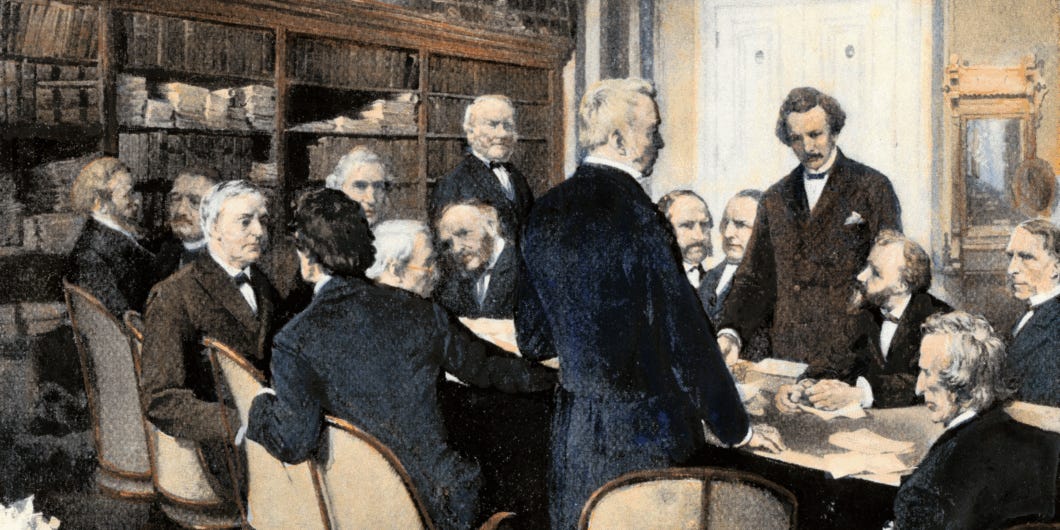
In December of 1865, the U.S. Congress formed the Joint Committee on Reconstruction and soon thereafter, the committee started drafting what would eventually become the Fourteenth Amendment, which was ratified into law on July 9, 1868.
A little more than two years of discussion, debate, and analysis went into creating the most significant amendment in American history, and we believe that the modern era needs to draw inspiration from the boldness and bravery of Reconstruction.
This is what The Reconstructionist is all about and this belief is also central to the work at my non-profit The Sustainable Culture Lab. Our current political and constitutional crisis requires bold and brave actions, and this is why we’ve decided to take the ambitious step of drafting a new Twenty-Eighth Amendment and releasing it on the Fourth of July.
This amendment draws inspiration from both the Fourteenth Amendment and the process undertaken by the Joint Committee to craft it.
Like the Fourteenth, our Twenty-Eighth represents a philosophical shift toward freedom, equality, and justice; and away from inequality, division, racism, and the monied interests of the powerful. And like the Fourteenth, this amendment does not focus on one singular issue. Instead it has twelve sections, and addresses human rights, voting rights, immigration, housing, education, and more. In length, our amendment is roughly four times the length of the Fourteenth, and would be far and away the longest amendment in American history.
Just like the Fourteenth Amendment did in 1868, this amendment aspires to reconstruct the United States into a more authentic and just democracy and society.
Human rights attorney Michael Pates, my collaborator on this project who was integral in drafting the amendment, wrote a wonderful essay for cylindr magazine about the importance of creating a Twenty-Eighth Amendment.
Below you can find the first draft of the amendment and you can also find it on The Sustainable Culture Lab’s website.
Honestly, I would love to hear your thoughts. We do not intend for this version of the amendment to be the final draft. The hope is that this draft prompts thoughtful, intentional, and meaningful discussion that can produce a revolutionary document on par with the Fourteenth Amendment by 2028.
In the 1860s, the Joint Committee knew that this process would take time and that it needed to balance the demands and needs of both public and private discourse. The voices of newly-freed Black Americans needed to be and were a part of the public discourse along with those of the Republican congressmen who could draft and implement legislation and constitutional amendments. The committee’s fifteen members even created a detailed journal of their work and decisions, but did not record the details of their internal discussions.
In our process, we also aspire to maintain that necessary balance so that the best possible amendment can be drafted.
Lastly, and this point may seem counterintuitive, but the significance of the amendment does not exclusively reside with its ratification, and the Fourteenth Amendment and the Joint Committee prove this.
In 1868, many Republican congressmen were underwhelmed by the Fourteenth Amendment because it did not include Black male suffrage. The Fourteenth was not ambitious enough for American politicians in the 1860s. In the end, the amendment was ratified in the summer of 1868, and would allow Southern states enough time to ratify the amendment so that they could get readmitted to the Union, and could participate in the national elections in 1868.
As a result, many Republican candidates in the South campaigned on a pro-Black suffrage platform, won their elections, and Black male suffrage became the law in many Southern states prior to the ratification of the Fifteenth Amendment.
Additionally, the work of the Joint Committee that preceded the Fourteenth Amendment also radically changed America for the better. From the recommendations of the Committee, Congress passed the Civil Rights Act of 1866 and created the Freedmen’s Bureau. And not only was John Bingham the primary author of the Fourteenth Amendment, but he also coined the moniker “Bill of Rights” to describe the first ten amendments.
Also, and this fact is almost always overlooked, but one of the first tasks of the committee was to determine what to do with the former Confederate states and their leaders, many of whom even had the gall to return to Congress and attempt to reclaim their pre-Civil War seats. Even Alexander Stephens, the Vice President of the Confederacy, attempted to casually return to the House of Representatives and represent Georgia’s 8th congressional district.
The members of the Joint Committee soon realized that Southern politicians wanted to continue the Civil War in the halls of Congress, so not only did they help prevent a legislative civil war in Congress but they also charted the pathway to reconstruct America.
I say this because the Fourteenth Amendment was part of the process and not the end goal. Each part of that process reconstructed America for the better.
Our Twenty-Eighth Amendment hopes to help cultivate a similar, yet modern-day process of reconstructing America.
Amendment XXVIII
(Draft 7.4.26)
Section I: Human Dignity
All human beings are born free and equal in dignity and rights, and shall enjoy the full protections and benefits of the law on that basis.
The foreign policy of the United States shall reflect this principle and be founded upon responsible national defense, humanitarian engagement, and a just rule of law.
Section II: Equal Rights
Equality of rights under the law shall not be denied or abridged by the United States or by any State on account of sex, race, disability, sexual orientation, national origin, or gender identity.
Section III: Citizenship and Immigration
All persons born or naturalized in the United States, and subject to the jurisdiction thereof, are citizens of the United States and of the State wherein they reside, regardless of other circumstances.
The courts shall give full effect to the Privileges and Immunities Clause of the Fourteenth Amendment.
The Federal government has exclusive authority to regulate and police national borders, and shall do so consistent with international human rights standards.
Persons arriving at the borders of the United States and presenting colorable claims of asylum shall be granted permission to enter and remain in the United States pending final adjudication of their claims. Persons without a legitimate basis for remaining shall be subject to deportation.
The Congress shall establish the processes and provide the resources, including judges and competent defense counsel, necessary and sufficient to ensure a humane, stable, consistent, and efficient immigration system, including safe conditions for minor children immigrating with or without their parents. Family separation is prohibited.
Section IV: Voting and Elections
All citizens of the United States aged 18 years or older have the right to vote and shall be automatically registered for that purpose. No test or form of identification shall be required to vote.
The right to vote shall not be abridged by reason of criminal conviction except for mass voter fraud, voter suppression, or waging insurrection against the United States, in which cases it shall be suspended for 10 years from the date of conviction unless committed while under oath to the Constitution, in which case it shall be permanent and disqualifying from elected or appointed office or military service.
The Electoral College is abolished. The President of the United States shall be elected by popular vote.
Primary elections shall be open, unrestricted by party affiliation.
Election day for Federal and State elections, including primary and general elections, shall be an official holiday.
Election campaign donations, loans, and expenditures are not speech under the First Amendment. The Congress and the States may regulate them accordingly.
Foreign campaign contributions of any kind to candidates, campaigns, and independent committees are prohibited.
The protections afforded under the Fifteenth Amendment are not restricted to State action but apply also to discriminatory private action, and regardless of intent in either case.
Redistricting shall be conducted by the States simultaneously and only once per decade; be based on national census data; and be performed equitably by independent bipartisan or nonpartisan commissions appointed by the States.
Census data shall encompass all residents regardless of their citizenship status.
Section V: Right to Education
All children have the right to a good-quality public education free of religious or political indoctrination.
The States shall fund public schools and education-related services equitably based on need statewide, and not on property or other tax assessments per school district.
The Congress has power to augment State funding and regulation of education at all levels to ensure and enhance its quality nationwide.
Section VI: Right to Good-Quality Health Care, Food, Housing, and Environment
All persons have the right to good-quality health care, food, housing, and a healthful environment.
The Congress and the States shall ensure that all persons have reliable and equitable access to services and resources necessary to secure these rights.
Section VII: Right to Economic Activity and Benefits
All persons have the right to engage freely in economic activity as regulated by law.
All persons who were once subject to criminal conviction(s), having fulfilled their sentences or other legal penalties based thereon, have the right to engage in employment and economic activity without reference to their prior conviction(s).
Economies exist to serve human needs and, therefore, belong to everyone. Accordingly, Congress and the States shall ensure an economic system founded on democratic capitalism regulated to serve human needs and to maximize the security and enjoyment of the constitutional, civil, and human rights of all.
Business entities do not have the rights of natural persons. The Congress and the States may regulate their activities, including speech.
Business entities shall state a public purpose(s) in their governing document(s) and shall pursue such purpose(s) subject to their termination for failure to do so.
Limited liability shall not shield or absolve business-entity executives, agents, or boards of personal civil or criminal liability for corporate acts that harm human rights and were committed intentionally or in willful recklessness or gross negligence.
The Congress has power to regulate artificial intelligence, social media platforms, and comparable technologies, including their algorithms, pursuant to the public interest.
The Congress shall establish a national livable wage, to be adjusted annually by State according to official cost-of-living data.
The Congress shall impose and collect a minimum tax of 15 percent on corporate income, from whatever source derived.
The Congress and the States shall ensure a progressive income tax system, with emphasis on taxing passive investment income and capital gains over wages from labor.
Section VIII: Right to Privacy
All persons have the right to privacy and to security from governmental intrusion into their persons, houses, papers, effects, and data, consistent with the Fourth Amendment, which shall be interpreted in light of this Article.
All persons have the right to bodily autonomy, including in reproductive and health care decisionmaking.
Marriage is a legal state of matrimony between two biologically unrelated consenting persons aged 18 years or older.
The right of the people to keep and bear arms under the Second Amendment extends only to personal protection and sporting purposes and, in any case, does not extend to possession of military-grade weaponry. Congress and the States have power to regulate the exercise of this right pursuant to the public interest.
Section IX: Right to Civil and Criminal Justice
The Congress and the States shall ensure access to good-quality, reliable, and adequate civil and criminal legal services for persons unable to afford them, and shall provide the funding necessary to secure them.
Capital punishment is prohibited.
The rights set forth in this Constitution are “established” for purposes of determining qualified immunity for government officers and agents, and need not be reflected in prior case law.
Federal, State, and local jails and prisons shall be funded, managed, and operated by government agencies and not by for-profit businesses or contractors, and shall ensure the safety, wellness, and humane treatment of prisoners.
Federal, State, and local prosecutors, police, and courts shall emphasize community policing methods and prioritize public-health-based approaches to charging and sentencing practices.
The Federal government may exercise universal jurisdiction to apprehend and try persons credibly accused of genocide, crimes against humanity, war crimes, and torture under international law.
Section X: Separation of Powers and Governmental Integrity
The Congress has power to establish, fund, regulate, and oversee Executive agencies or units that are independent of the President’s authority.
The President shall take care that the laws, and agency regulations duly established by reasonable inference drawn therefrom, be faithfully executed.
The pardon power does not extend to self-pardoning by the President or to political appointees or staff of the President’s administration, but they may be pardoned by a subsequent President in the public interest.
The filibuster is prohibited. Legislation shall be passed by a simple majority of the House of Representatives and of the Senate.
The Supreme Court shall be comprised of one Justice for each judicial circuit, of which there shall be only 13; and the term for each Justice and Federal judge shall be limited to 18 years, with those having attained or exceeded such tenure upon ratification of this Article to serve no more than three additional years unless age-limited.
The judicial appointments process shall not be affected by election cycles.
The Congress shall establish and enforce a code of ethics for the Supreme Court and the Federal judiciary.
The Congress and the States shall ensure that elected or appointed government officials and their families shall not profit financially from their government service during such service.
No person shall serve as United States Representative, Senator, President, or Federal judge or Justice, after attaining the age of 76 years.
At least once every 20 years, the Congress formally shall assess whether to amend this Constitution.
Section XI: Statehood
The District of Columbia shall be a State.
Any territory of the United States shall be granted statehood upon an affirmative majority vote of its population by way of a referendum. No such referendum shall be held more than once in ten years.
No State may secede from the United States.
Section XII: Enforcement
The Congress shall have power to enforce, by appropriate legislation, the provisions of this Article, including as based on data and other reliable evidence regarding inequitable racial, economic, or other impacts or disparities.
To the extent that the provisions of this Article conflict with those of another, the conflict shall be resolved in favor of the affected community(ies), human rights norms and obligations, and just rule-of-law principles.
This Article shall become effective within five years of its ratification by the requisite number of States.
Too many topics for one amendment. This is a whole new constitution. Politically it makes more sense to offer multiple amendments that allow Congress to then pass legislation. Also, No. 1 on the list should be repealing the exception clause in the 13th amendment that allows penal institutions to used forced labor.
Presidents cannot hold office if they are criminals.