


The midterms have given the Democratic Party an historic opportunity to transform America for the better, but they could squander this opportunity (and thus far, it looks like they may) if they do not learn from history and the era that birthed civil rights, voting rights, and equality in America.
Last Tuesday was a moment of electoral destruction almost on par with the one post-Watergate, yet that’s not the only, or even the most important, era that Democrats should draw lessons and inspiration from.
Democrats need to look at Reconstruction (1865-1877) as well because post-Civil War America was defined by an unprecedented political earthquake that gave the nascent Republican Party an historic opportunity to radically alter the United States. At the start of Reconstruction, the Republican Party had existed only 11 years, yet in the next five years they forever changed the United States for the better by moving quickly to implement monumental civil rights reforms. The political turmoil of Reconstruction was both far more significant than Watergate and far more similar to the present.
If the Democrats want to use their electoral successes to make history today, they need to focus on the tactics and goals of Reconstruction, and the more closely one examines this history, the parallels to the present become unmistakable.
Yet Reconstruction was 150 years ago and not relatively fresh in our political awareness like Watergate, so let me paint the picture of the past and four key lessons from Reconstruction that the Democrats must learn if they do not want to waste this opportunity.
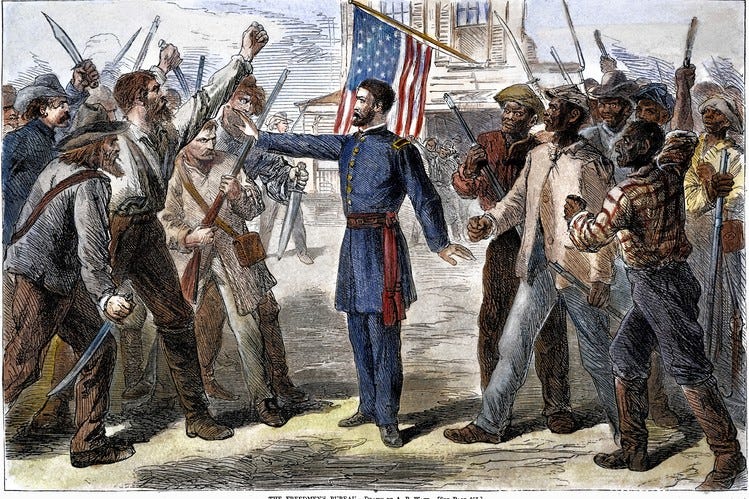
In 1865, not only was the Civil War a gargantuan military defeat for the South, but it was also an apocalyptic political defeat. Prior to the Civil War, most Southern politicians belonged to the Democratic Party, which was founded under Andrew Jackson around 1828. When the South launched the Civil War, its legislators left Congress to join the Confederacy, but Democrats outside the South, who did not join the Confederacy, kept their seats.
What may surprise most Americans is that once the Civil War ended, the defeated Southern legislators attempted to return to Congress to reclaim their seats as though nothing had happened. They hoped that their legislative colleagues would just overlook secession in the name of bipartisanship and national unity.
In an attempt at congeniality, the Republican congressmen did interview their Democratic Southern colleagues to learn whether they genuinely wanted to work together and abolish slavery and improve the lives of Black Americans. It quickly became evident, though, that these Southern politicians had not changed their ways and intended to transition the war over slavery from the battlefield to the legislature. To prevent a legislative Civil War, therefore, the Republican-controlled 39th Congress refused to immediately readmit the former Confederate states, leaving them without congressional representation.
This decision - to hold wrongdoers accountable - amounted to a massive political defeat for the mostly Southern Democratic Party that was unprecedented in American history. In 1865, 24 seats in the Senate and 59 in the House were vacant.
The Republican Party thus found themselves with a massive and unanticipated political opportunity. Yet they still had to deal with an uncompromising, albeit severely weakened, opposition party.
The realities of 1865 and 2026 have striking similarities, yet despite the transformational impact of the last Tuesday’s Blue tsunami, there is still a deep concern that the Democratic Party may lack both the leadership and vision that this moment calls for. What Democrats do next is of primary importance.
The people who voted and fought for the most recent Election Day victories expect Democratic leaders to expeditiously improve their quality of life and hold wrongdoers in Congress and the Trump administration accountable. While this moment is not about reuniting a country riven by secession and Civil War, today’s legal and ethical wrongdoing likewise demands accountability for the integrity of our constitutional republic.
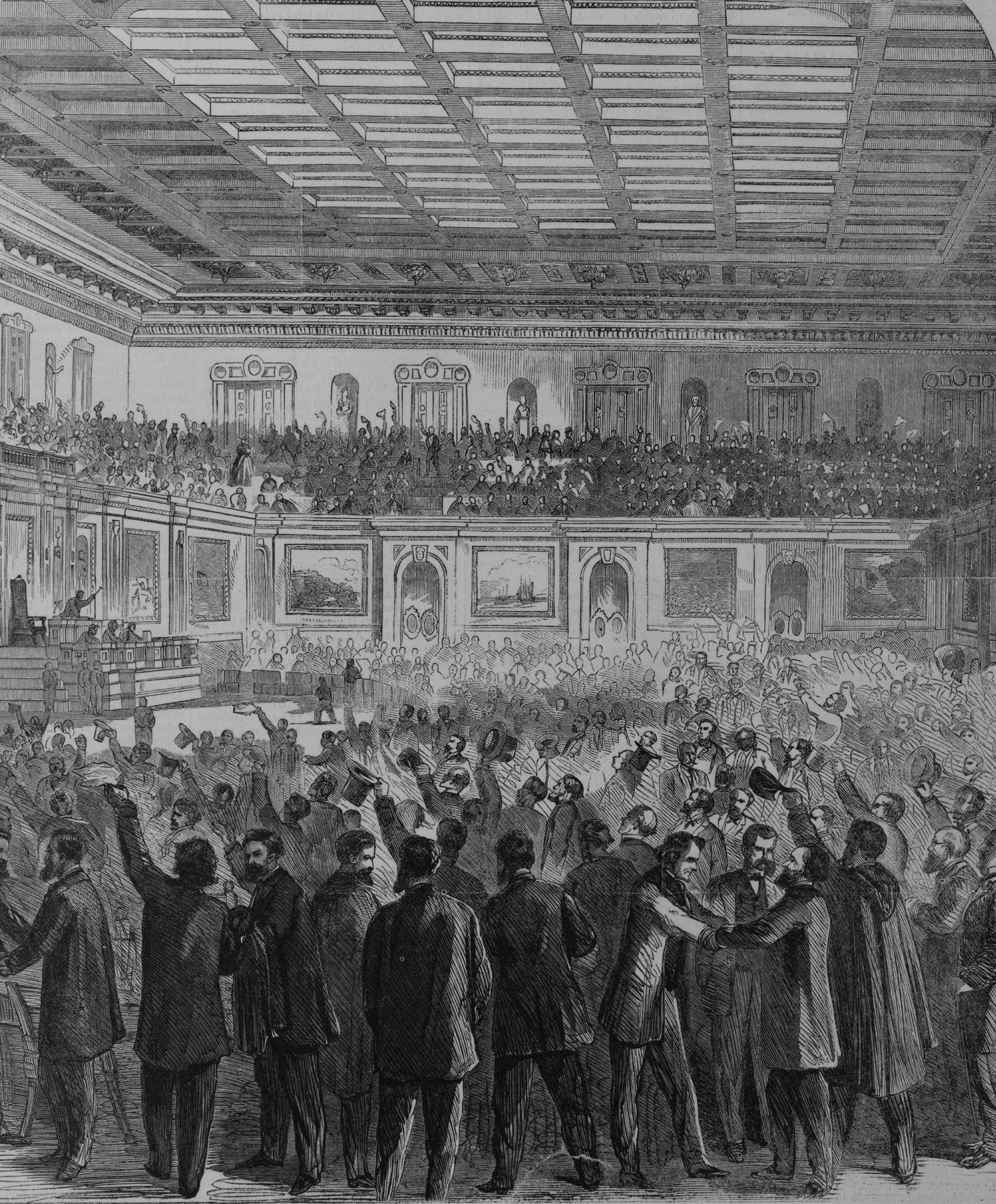
In the 1860s, the Reconstruction effort was confronted with four important tasks that could reshape the future of the United States, and they succeeded in three of them. Today, the Democratic Party is confronted with the same tasks.
Fighting the moderate agenda: During Reconstruction, the Republican Party first addressed the leadership vacuum caused by President Lincoln’s assassination by fighting his recalcitrant successor, President Andrew Johnson, tooth-and-nail for his entire presidency; finally replacing him in the next election with former Civil War general Ulysses S. Grant, who not only supported Reconstruction but was willing to use military force to suppress rebellions in the South and the rise of white supremacist militias such as the Ku Klux Klan.
The Republican Party fought against Republican President Andrew Johnson because Johnson’s political agenda prioritized trying to work with defiant Democrats instead of implementing Reconstruction. During an historic moment that called for radical change, Johnson wanted to be a moderate who emphasized bipartisanship and the norms of the past instead of advancing civil rights and improving the lives of the American people.
Naming the effort “Reconstruction”: The Republicans acknowledged that their gargantuan task equated to reconstructing the United States from the bottom up, so they called their vision and agenda “Reconstruction.” This agenda was so impactful and transformative that its name would define the era.
Daring to dream big: Political leaders during Reconstruction were unafraid to introduce and build support for bold and sweeping change. Many members of the Republican Party even began calling themselves “Radical Republicans.” Their “radical” ideas included abolishing slavery in the Constitution, legalizing civil rights, expanding voting rights to Black men, ensuring equal protection under the law, and making the Bill of Rights federally enforceable. They also created the Department of Justice, the Department of Education, and the Freedmen’s Bureau – all of which would have been considered absurd and impossible prior to the Civil War.
The radical ideas of Reconstruction later influenced FDR’s New Deal, which today inspires politicians like Bernie Sanders, Alexandria Ocasio-Cortez, and Abdul El-Sayed, and “radical” policy items such as Medicare for All. The Freedmen’s Bureau, in particular, which was created in 1865, was the precursor to the New Deal, which was launched in 1933, but the policies of Reconstruction were more racially inclusive than those of the New Deal. America’s diversity means that we should draw more inspiration from the era that created multiracial democracy in America – Reconstruction – than from policy accomplishments clouded by the stain of Jim Crow.
The biggest failure of Reconstruction was the failure to prosecute the treasonous former Confederates. This flawed strategy helped to bring about the premature end of Reconstruction.
To curry favor with the Democrats, President Johnson – to the strong objection of his own party – agreed to pardon essentially all of the former Confederate soldiers, officers, and politicians. Not even Jefferson Davis, the president of the Confederacy, went on trial. Yet Johnson’s “bipartisanship” only alienated him from his own party, and the Democrats never embraced him. Following his impeachment in 1868, Johnson decided to run for president as a Democrat, but he failed to win their nomination. He was merely a pawn that the Democrats had used to increase their power.
In pardoning the Confederates, Johnson gave new strength to a party on life support. Their pardoned soldiers quickly formed white supremacist militias, and their politicians started running for elected office. From 1868 to 1877, Democrats in the South, through a combination of terrorism and political maneuvering, started reclaiming more and more control; by 1877, they brought forth the end of Reconstruction.
Today’s Democrats face a similar task as the Republicans of 1865. They need to decide their leadership, create and implement a policy vision on par with Reconstruction, and investigate and prosecute political corruption and criminality.
If Tuesday’s decision not to pursue impeachment proceedings against Secretary of Defense Pete Hegseth is any indication, it looks as though the Democrats might squander this historic opportunity and not accomplish any of these objectives.
If the Democrats do not succeed on these four tasks, they will blow this historic moment.